Ocala, Florida | November 25, 2026 | Translated from Official Japanese Press Release with Archival Context


Pro wrestling has a pretty ugly track record when it comes to taking care of its elders. For decades, the business has treated workers as interchangeable parts, celebrating them while they draw money and moving on the second the body slows down. So when a room fills up across generations to honor a man months after his passing, it is worth pausing to look at what actually built that loyalty.
Beginning at 1:00 PM local US time on November 25, friends, peers, and former students gathered at Good Shepherd Memorial Gardens in Ocala, Florida, for the “Dory Funk Jr. Public Memorial Service,” following Dory’s death at age 85 at his Ocala home on August 4, 2026. According to an official press release detailing the service, the lineup of speakers who stepped up to deliver eulogies read like a map of modern wrestling history. Rob Van Dam, who also competed in All Japan Pro Wrestling, was there. So were Steve Corino, Gerald Brisco, and Atsushi Onita, among others.
Look at that last name on the list. On paper, Atsushi Onita and Dory Funk Jr. represent two completely different worlds of professional wrestling. One is synonymous with technical mat fundamentals and old-school NWA championship poise. The other built an entire outlaw genre out of barbed wire and explosives. Yet if you zoom out and look at how the wrestling industry actually functioned in the 1970s, their five-decade bond makes complete sense.
Archival Dossier: Dory Funk Jr. & Atsushi Onita (1973 to 2026)
- 1973: Fresh off his 1969 to 1973 NWA World Heavyweight Championship reign, Dory Funk Jr. debuts for All Japan Pro Wrestling (AJPW). That same year, a 15-year-old Atsushi Onita enters AJPW as the dojo’s first homegrown trainee before debuting on April 14, 1974 against Akio Sato.
- 1977 to 1982: Dory and Terry Funk win AJPW’s World’s Strongest Tag Determination League three times (1977, 1979, and 1982), while the Funk territory in Amarillo, Texas operates as AJPW’s official American training base. Onita trains under Dory, is sheltered by Terry in Amarillo, and wins the NWA International Junior Heavyweight Championship in 1982.
- April 20, 1983 to January 3, 1985: Onita suffers a compound fracture of his left kneecap at Tokyo Metropolitan Gymnasium after a title defense against Héctor Guerrero, leading to his December 2, 1984 retirement match against Mighty Inoue and formal retirement on January 3, 1985.
- 1989 to 1993: Returning in late 1988, Onita founds FMW in 1989, stages the first No Rope Exploding Barbed Wire Deathmatch (“Current Blast”) against Tarzan Goto on August 4, 1990, and defeats Terry Funk in 12:14 in Kawasaki on May 5, 1993.
- August 24, 2024: At age 83, Dory Funk Jr. teams with Osamu Nishimura to defeat Atsushi Onita and Raijin Yaguchi in 13:05 in a Double Hell Current Blast Deathmatch before a sellout crowd of 5,040 at Fujitsu Stadium Kawasaki, closing his 61-year in-ring career (1963 to 2024).
- August 4 to November 25, 2026: Dory Funk Jr. passes away at age 85 at his home in Ocala, Florida on August 4, 2026. On November 25, 2026, Onita joins Rob Van Dam, Steve Corino, and Gerald Brisco to deliver eulogies at Good Shepherd Memorial Gardens in Ocala.
The 1973 Pipeline That Built a Generation
To understand why Onita flew to Florida to speak at Dory’s memorial, you have to understand how the old territory system moved talent across the Pacific. Both men entered All Japan Pro Wrestling (AJPW) in 1973, standing at opposite ends of the locker room hierarchy.
Fresh off his 1969 to 1973 reign as NWA World Heavyweight Champion, Dory Funk Jr. arrived in AJPW as a marquee pillar, anchoring the promotion’s foreign roster alongside his younger brother Terry Funk. Together as The Funks, the brothers won AJPW’s World’s Strongest Tag Determination League three times in 1977, 1979, and 1982, while Dory also captured the NWA International Heavyweight Championship twice. More importantly from a structural standpoint, the Funk family’s territory in Amarillo, Texas operated as AJPW’s official American training base.
That pipeline is where a 15-year-old Atsushi Onita entered the picture. Joining AJPW in 1973 as the dojo’s first true homegrown trainee before debuting on April 14, 1974 against Akio Sato, Onita learned wrestling directly under Dory Funk Jr. When Onita went on his overseas excursion, he also built a close bond with Terry Funk, who sheltered him in Amarillo and recommended him for junior heavyweight title contention. This was not a corporate training center. It was a traveling family business where veterans literally housed young rookies from halfway around the world.
That foundation carried Onita to the top of AJPW’s junior heavyweight division, where he became the promotion’s junior heavyweight ace, capturing the NWA International Junior Heavyweight Championship in 1982 and the All Asia Tag Team Championship with Masanobu Fuchi. Then the physical toll of the job stepped in. On April 20, 1983 at Tokyo Metropolitan Gymnasium, Onita slipped off the ring apron during a post-match altercation following a title defense against Héctor Guerrero and suffered a compound fracture of his left kneecap. He fought through a year-long recovery and made a comeback in May 1984, but the original path was gone. Onita lost a retirement match to Mighty Inoue on December 2, 1984 and formally retired on January 3, 1985.
Here is the reality of wrestling labor that fans sometimes overlook. When a body breaks down under the traditional style, a wrestler either walks away forever or reinvents the form to survive. Returning to the ring in late 1988, Onita founded Frontier Martial-Arts Wrestling (FMW) in 1989 and created the first-ever No Rope Exploding Barbed Wire Deathmatch, known as “Current Blast,” against Tarzan Goto on August 4, 1990. Even after moving into deathmatches, Onita never severed his roots with the Funks. On May 5, 1993 in Kawasaki, Onita defeated Terry Funk in 12:14 in a No Rope Exploding Barbed Wire Time Bomb Deathmatch, famously diving over an injured Terry to shield him from the post-match ring explosion.
Denryu Bakuha (電流爆破, Current Blast): Atsushi Onita’s signature explosive barbed-wire deathmatch stipulation, first staged in FMW in August 1990 and officially stylized in English across Onita’s promotions and events as “Current Blast.”
When a body breaks down under the traditional style, a wrestler either walks away forever or reinvents the form to survive.
One Last Night in Kawasaki
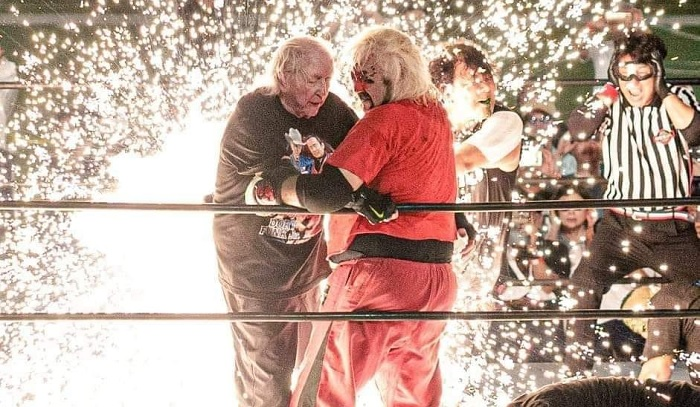
That shared history came full circle more than three decades later. On August 24, 2024, one year after Terry Funk’s death in August 2023, FMW-E staged the Terry Funk 1st Anniversary Memorial & Atsushi Onita 50th Anniversary Show “Kawasaki Legend 2024” before a sellout crowd of 5,040 at Fujitsu Stadium Kawasaki, built on the site of the former stadium where Onita and Terry had fought in 1993.
The show marked Dory Funk Jr.’s first trip to Japan since November 2019. And to be fair, looking at it from the outside, seeing an 83-year-old legend step into a ring lined with explosives can make anyone wince about what this industry asks of its veterans. Yet when you look at who was standing in that ring with him, the decision reads less like a stunt and more like a final act of family and professional solidarity.
In the main event, Dory Funk Jr. teamed with his longtime protégé Osamu Nishimura, who was competing while undergoing cancer treatment, against Atsushi Onita and Raijin Yaguchi. The stipulation was the Kawasaki Legend 2024 Double Hell Current Blast Deathmatch, featuring exploding landmines along the north and south sides of the ring, exploding barbed wire along the east and west sides, and four exploding barbed-wire bats. At age 83, Dory surpassed Great Kojika’s age-81 mark to become the oldest wrestler to compete in a Current Blast match. Walking out to the ring carrying a photograph of Terry and his late brother’s ring jacket, Dory brought the entire Funk legacy into Onita’s house.
He did not hide in the corner, either. During the 13:05 bout, Dory traded elbow smashes with Onita and absorbed a direct exploding bat strike from his former pupil. After Nishimura sent Onita and Yaguchi into the ringside landmines and struck Yaguchi with an exploding bat, Dory locked Yaguchi in his signature Spinning Toe Hold before tagging in Nishimura, who cinched in a Spinning Toe Hold of his own to force Yaguchi to submit. After the victory, Dory repeatedly shouted “Never quit! Forever!” to the Kawasaki crowd. That night stood as Dory Funk Jr.’s final appearance in Japan and the closing match of a 61-year in-ring career that stretched from 1963 to 2024.
Voices at the Podium in Ocala
All of that weight was sitting in the room in Ocala on November 25. When Steve Corino stepped up to speak, he summed up the difference between someone who merely teaches holds and someone who actually mentors young workers.
“Dory was not just a wrestling coach, he was a teacher of life,” Corino said.
Rob Van Dam mixed humor into his remarks, sharing stories including the time Dory took him to a Chinese restaurant during his first trip to Japan in 1993 to compete for All Japan Pro Wrestling. Anyone who has ever been a young worker landing overseas for the first time knows what a small gesture like a meal from a respected veteran means when you are thousands of miles from home.
Hatsu Rainichi (初来日, first tour of Japan) and Sansen (参戦, competing in a promotion): Standard Japanese wrestling press terms used in the source release to describe Rob Van Dam’s 1993 debut tour with All Japan Pro Wrestling. The release also notes that Van Dam spoke warai wo majiete (笑いを交えて語った, mixing humor into his remarks) to reflect the warm tone of his tribute.
Then a friend of Dory’s spoke about the restlessness that kept him pushing forward well into his eighties, even as his health caught up with him.
“Dory was always thinking ahead and talking about the future,” the friend said in a eulogy. “He was saying, ‘We’re going to put on a show in November, and Onita is coming.'”
That line hits hard because it explains who Dory Funk Jr. was right up to the end. He was still looking at the calendar, still building cards in his head, and still counting on his former student from 1973 to walk through the door.
Onita took the podium last and delivered his speech in English.
“Dory once taught me wrestling. After joining All Japan Pro Wrestling at age 15 and retiring due to a knee injury, I created Current Blast. In 2024, in Kawasaki, Dory stepped into that Current Blast ring for me. I am grateful from the bottom of my heart. If it had been possible, I would have wanted to face Dory in a singles match.”
Agatte kureta (上がってくれた) and Kanau koto nara (叶うことなら): In rendering Onita’s English podium speech into Japanese, the press release pairs ringu ni agaru (to step into the ring) with the benefactive auxiliary -te kureta, framing Dory’s 2024 Kawasaki appearance as a personal act of grace done for Onita. Kanau koto nara (“if this wish could have been granted”) carries the formal, wistful weight of his unfulfilled desire for a singles match.
“If it had been possible, I would have wanted to face Dory in a singles match.”
– Atsushi Onita, Good Shepherd Memorial Gardens, Ocala, Florida (November 25, 2026)
What Remains When the Territories Are Gone
The structural world that connected Amarillo, Texas to All Japan Pro Wrestling is gone and is never coming back. Modern wrestling runs on centralized performance centers, short-term contracts, and corporate content cycles. The old territory system had plenty of flaws, from brutal schedules to minimal worker protections, and nobody needs to romanticize all of it.
What the service in Ocala reminds us, though, is what that older system produced when the right people held the keys. It produced teachers who cared about the person underneath the gimmick, and students who carried that gratitude for fifty years. Dory Funk Jr. met a 15-year-old kid in 1973, helped shape his career, and at 83 years old walked into fire in Kawasaki just to honor his brother and stand across from that student one last time. Even after the final bell rang in August, the respect Dory built brought everyone right back to Florida in November, just like he said it would.