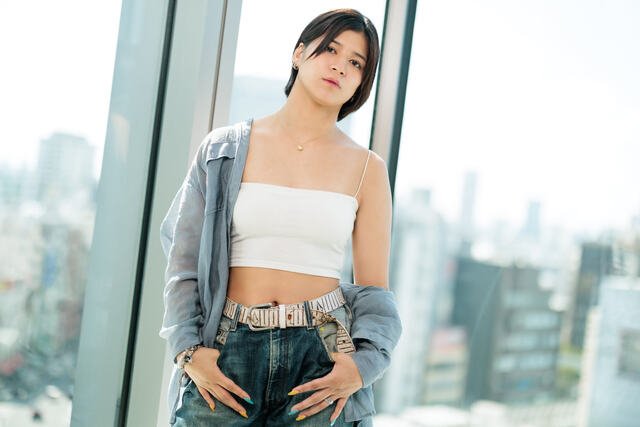
Making her professional wrestling debut in January 2025, Seri Yamaoka has garnered massive attention as a “Super Rookie.” While she enjoyed a spectacular debut, she has also faced the difficult reality of being expected to consistently exceed the audience’s expectations in the ring. Despite this, she possesses absolute confidence in the ground game (newaza) she cultivated through her amateur wrestling background. Her ultimate goals are to stand at the pinnacle of Dream Star Fighting Marigold and to challenge herself on the world’s grandest stage: WWE. In the second half of this interview, ENTAME next spoke with her about the pressure she felt post-debut, how her amateur wrestling experience serves as a weapon, how she spends her time away from the ring due to injury, and her future in both professional wrestling and gravure modeling.
—— You transitioned from amateur wrestling to professional wrestling after an injury. Do you still vividly remember your January 2025 debut match?
Yamaoka: Yes, of course I remember it. Strangely enough, though, I wasn’t nervous at all for my debut match.
—— That’s surprising. Was it actually more difficult after that?
Yamaoka: That’s right. I actually started getting really nervous about a month after my debut. Leading up to it, my only goal was simply “to debut,” but once I crossed that finish line, my mindset shifted to, “Now I have to show them a proper match.” That’s when I started feeling the pressure, and there was a period where things just weren’t going the way I wanted them to.
—— What aspects of professional wrestling do you find most difficult?
Yamaoka: You can’t betray the fans’ expectations, and there’s also the “conversation” you have with the audience during a match. It’s incredibly difficult. The more I think about it, the more challenges seem to pop up. I don’t think there will ever be an end to it, no matter how many years I do this.
—— Does carrying the heavy expectation of being a “Super Rookie” add to that pressure?
Yamaoka: Of course it does. But more than that, whenever a match card is announced, I find myself wondering, “Just how high are the fans’ expectations for this?” I know I have to exceed them. I can’t tarnish my own name, and I’m carrying the promotion on my back as well, so my desire to live up to all those expectations is extremely strong.
—— Where do you feel your amateur wrestling experience serves you best?
Yamaoka: The ground game (newaza). If we’re talking about within this promotion, I don’t think there is anyone who can beat me on the mat.
—— You have the confidence to declare it that boldly.
Yamaoka: I do. The ground game is absolutely crucial when it comes to submitting an opponent or gaining an advantageous position. Personally, the wrestlers I find most compelling are the ones whose ground game is stronger or more skillful than my own. If they aren’t that kind of opponent, I just don’t feel that urge of “I want to wrestle this person.”
—— Do you sometimes feel a sense of dissatisfaction regarding that aspect within your current promotion?
Yamaoka: Honestly, yes. But that is exactly why I want the entire promotion to level up. I want everyone’s mindset to change, and I want to be a part of changing the promotion together with them.
—— Does that mindset tie into your ambitions to challenge yourself overseas?
Yamaoka: Yes. Making it to WWE has been my goal since before I even debuted.
—— What draws you to WWE?
Yamaoka: I deeply admire Giulia, who is in WWE right now, and my goal is to surpass her one day. Also, WWE has so many wrestlers with styles entirely different from what you see in Japan, and I want to experience that world for myself. It would be amazing to become number one in Japan and then become number one in WWE too. I want to become a wrestler who surpasses both Giulia and IYO SKY.
—— You’ve also been doing gravure modeling alongside professional wrestling. Was there any hesitation about taking that on?
Yamaoka: None at all. I watched my older sister do it, and I always had the desire to try gravure myself, so when I received the offer, my immediate reaction was, “Yes!” I was genuinely thrilled.
—— You’ve even co-starred with your sister in gravure shoots.
Yamaoka: Yes. Being able to work together with her made me really happy. I don’t feel any sense of rivalry with her at all.
—— Do you learn things from your sister as your senior in the gravure industry?
Yamaoka: Definitely. I think she is incredibly skilled at knowing how to present herself, so I use her as a reference. But the way we smile and our facial expressions are a bit different, so I’m studying her presentation techniques while making sure to let my own personality shine through.
—— What do you consider to be your greatest weapon in gravure?
Yamaoka: It has to be my muscles. That’s what I want people to look at the most. I’m especially confident in my neck. I built it up through amateur wrestling. (laughs)
—— Is there anything you’d like to try next in gravure?
Yamaoka: I’ve never done a shoot at the ocean, so I’d love to shoot in Hawaii or Guam. Also, I haven’t released a photobook yet, so I want to tackle that. I’d be ecstatic if we could release a sister photobook someday.
—— Returning to professional wrestling, you are currently sidelined with an injury. Did your past experiences in amateur wrestling help you handle it mentally?
Yamaoka: I’m used to injuries, so in that sense, I was fine. But I do have this lingering anxiety of, “What if I dislocate it again?” However, getting stuck in a negative mindset will truly ruin me, so I’m focusing on doing the things I can only do right now.
—— What kind of things, for example?
Yamaoka: I’ve been watching matches objectively and observing the promotion as a whole. There are actually quite a few things you only notice when you aren’t standing in the ring. Plus, I’m able to enjoy my hobbies right now—doing my nails, sewing, and playing the piano. I’ve also been able to dedicate a lot of time to weight training.
—— We hear you’re aiming to make your return at the Ryogoku Kokugikan show on October 24th.
Yamaoka: Yes. I’m hoping I can have a singles match against either Sareee or Hiroyo Matsumoto at that event.
—— So they are opponents you definitely want to face.
Yamaoka: Yes. Both of them are incredibly strong, so I want to wrestle them and be pushed to my limits. I’m also keeping an eye on the recently debuted Saira. She has a parkour background and pulls off amazing movements of a completely different style than mine. Up until now, I’ve mostly wrestled my seniors, so I’d really like to face my juniors as well.
—— Finally, please tell us your future goals.
Yamaoka: First and foremost, to stand at the top of Dream Star Fighting Marigold and lead the promotion. Next, to fight Giulia, Sareee, and Hiroyo Matsumoto in singles matches. Beyond that, I want to reach the pinnacle of the professional wrestling world and go to WWE. Finally, I want to spark a pro-wrestling boom and become a presence that leaves behind the name “Pro Wrestler Seri Yamaoka” in the entertainment world as well.
Translation & Localization Notes
- Super Rookie (スーパールーキー): In Japanese sports and wrestling media, this term is highly specific. It doesn’t just mean a rookie who is doing well; it denotes a generational, blue-chip prospect who is heavily pushed from day one and expected to immediately rival main-eventers.
- Newaza (寝技): Translated literally as “lying techniques,” it is localized here as the “ground game.” In puroresu and martial arts, it encompasses mat wrestling, pins, holds, and submissions—a direct nod to her legitimate amateur grappling pedigree.
- Gravure (グラビア): A staple of the Japanese entertainment industry, gravure modeling (often bikini/glamour photography) is heavily intertwined with Joshi puroresu. Many wrestlers participate in gravure to build their brands, and it is viewed as a standard mainstream media crossover rather than purely adult entertainment.
- Photobook (写真集 – shashinshu): Although Yamaoka has previously released the photobooks Chase Dreams I and Chase Dreams II, her comment about “never releasing a photobook” refers specifically to a major commercial release. In the Japanese gravure and entertainment industry, securing a high-budget, hardcover photobook published by a major mainstream publishing house (and distributed in nationwide physical bookstores) is treated as a prestigious, distinct career milestone, entirely separate from self-published, digital, or promotion-produced merchandise.
- Ryogoku Kokugikan (両国国技館): Tokyo’s famous Sumo Hall. Mentioning it emphasizes the high stakes of her targeted return, as it is one of the most prestigious arenas in Japanese professional wrestling.