Yaaaman!
Wednesday, October 7
How is everyone doing??
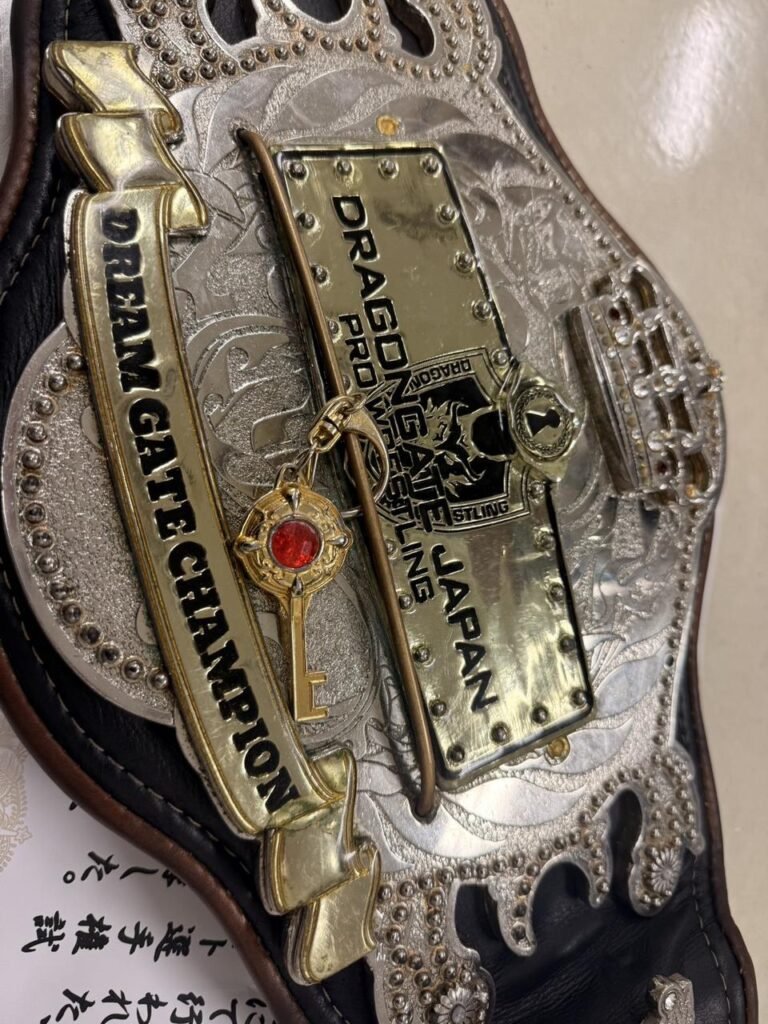
The other day at Korakuen Hall, I had my Dream Gate title defense against Yoshiki Kato.
As frustrating as it is to say, my defense failed..
The continuation of my dream came to an all-too-abrupt end..
Twenty years into my career, the door to my dream that I finally got my hands on—that I finally managed to pry open—was shut right in front of me by Yoshiki..
This is DRAGONGATE. This is pro wrestling.
Sad as it may be, I have to accept this reality.
Man, it’s tough, though~.
Well, if nothing else, I think it’s a positive thing that me winning the belt inspired someone who had never shown any interest in it before to step up and throw his name in the hat as a challenger.
That night at Korakuen also featured a memorial ceremony for PAC, and I really wanted to defend the Dream Gate and say a few words to PAC myself, you know..
Things just don’t always go the way you plan, huh.
But!
I’m nowhere near ready to give up yet.
I wrapped that belt around my waist once. I’ll open that gate again, just watch me.
The moment you give up on challenging yourself, it’s all over.
There’s nowhere to go from there but down.
I’m gonna keep on fighting for it!!
Losing the Dream Gate is frustrating enough on its own, but there’s something else eating at me—I don’t even know whether to call it frustrating, sad, pathetic, or just plain exasperating,,
I honestly don’t know how to put it into words..
During the match, I definitely took a pretty brutal move.
A clip of that spot made the rounds on social media,
and people have been swarming all over it just to make a big show of their outrage.
Like, hey—
I’m the one who actually took the move, you know (lol).
Why are people who didn’t even take the bump posting criticisms and negative takes like they’re a bunch of experts?
Pro wrestling is dangerous by nature.
What the hell even is “safe pro wrestling”?
It’s because it’s dangerous that we train our bodies so relentlessly, isn’t it?
Don’t underestimate pro wrestling.
Even people who clearly never watch DRAGONGATE on a regular basis are all piling on at once.
Spare me the whole “See, this is why modern pro wrestling is…” garbage.
Man, I really hate social media.
Of course we get injured sometimes.
We step into that ring knowing full well what we’re signing up for.
We put our lives on the line to take those moves.
And even then, we keep getting back up.
That’s the larger-than-life spectacle we’re out there trying to captivate you with.
I love that kind of pro wrestling with all my heart, and that’s the exact kind of pro wrestler I always wanted to be.
Don’t bring your mundane, real-world criticisms into a world built on defying reality.
Instead of pouring all your energy into typing out negative crap,
pour yourself into something that actually makes you positive.
Don’t go making your own life boring all by yourself.
A future that’s ours to build and define,
Where the possibilities are limitless and shine,
A brighter tomorrow we’ll keep making down the line—
That’s the kind of world I want on my mind.
Stop staring down at the ground—let’s keep our heads up and look straight ahead!
Translation Notes:
- “Yaaaman!” (
やーーまん!): Kzy’s signature opening greeting derives from Jamaican Patois (“Yah man”). It is a staple of his long-running reggae, street-dance, and hip-hop-inspired babyface persona (most notably as leader of the NATURAL VIBES faction). - The “Dream Gate” Lore (
ドリームゲート/夢の扉): DRAGONGATE’s top prize is the Open the Dream Gate Championship. When Kzy laments that “the door to my dream… was shut right in front of me” (ようやく開いた私の夢の扉は良輝によって閉められてしまいました), he is invoking both a metaphor and the literal physical design of the championship belt. The belt features a locked gate over its center plate; challengers carry a key that unlocks and opens the gate only if they win the title. For two decades, Kzy was known as DRAGONGATE’s ultimate hard-luck underdog who repeatedly fell short of the title, making his rapid loss of the belt on his first defense especially poignant. - Untranslatable Wordplay on Uchikomu (
打ち込む): Near the end of the column, Kzy writes:否定的な事ばっか打ち込んでないでポジティブになれる事に打ち込んでいけって。This relies on a double meaning of the verb uchikomu (打ち込む). In the first line, it means “to type / key in” text on a smartphone or keyboard (i.e., posting hate comments online). In the second line, it shifts to its idiomatic meaning: “to devote oneself wholeheartedly to / pour one’s energy into” a passion or pursuit. The translation bridges both meanings by pairing “pouring all your energy into typing out negative crap” with “pour yourself into something that actually makes you positive.” - Kanji Nuance in Misete iku (
魅せていく) & Higenjitsu (非現実): When Kzy writesそんな非現実を魅せていくんだよ, he deliberately substitutes the standard kanji for miseru (見せる, “to show”) with魅せる(using the character for “enchant,” “fascinate,” or “captivate”). In Japanese pro wrestling journalism,魅せるrefers to the art of mesmerizing an audience with spectacle and emotion rather than merely executing athletic maneuvers. He pairs this with非現実(literally “unreality” or “fantasy”), contrasting the larger-than-life, death-defying world inside the ring against the現実的な批判(“mundane, real-world criticisms”) of armchair critics. - Rap Cadence & Rhyme Scheme in the Closing Stanza: Drawing on his roots as a rapper (having debuted under the ring name m.c.KZ), Kzy drops a four-bar rhyming verse right before his sign-off, built around an -ai end-rhyme:
自分次第でつくれる未来(mirai — future)可能性は無限大(mugendai — infinite)これからもしてく明るい未来(mirai — future)そんな世界に期待したい(kitai shitai — want to hope for / look forward to)
下ばっか見てないで前上見ていこうぜ!— “Stop staring down at the ground…”) works as a double entendre: urging readers not to wallow in negativity, while subtly telling social media critics to stop staring down at their phone screens. - Register Shifts & Punctuation: Kzy’s distinctive writing style relies on trailing double periods (
。。) and double commas (、、) to visually convey a deflated sigh in the first half of the column. As his topic shifts from his title loss to online outrage, his register intentionally drops from polite, conversational prose (受け入れなければなりません/〜と思います) into raw, confrontational street slang (プロレス舐めんなって/〜じゃねぇよ), which is reflected in the English transition from measured reflection to blunt vernacular.