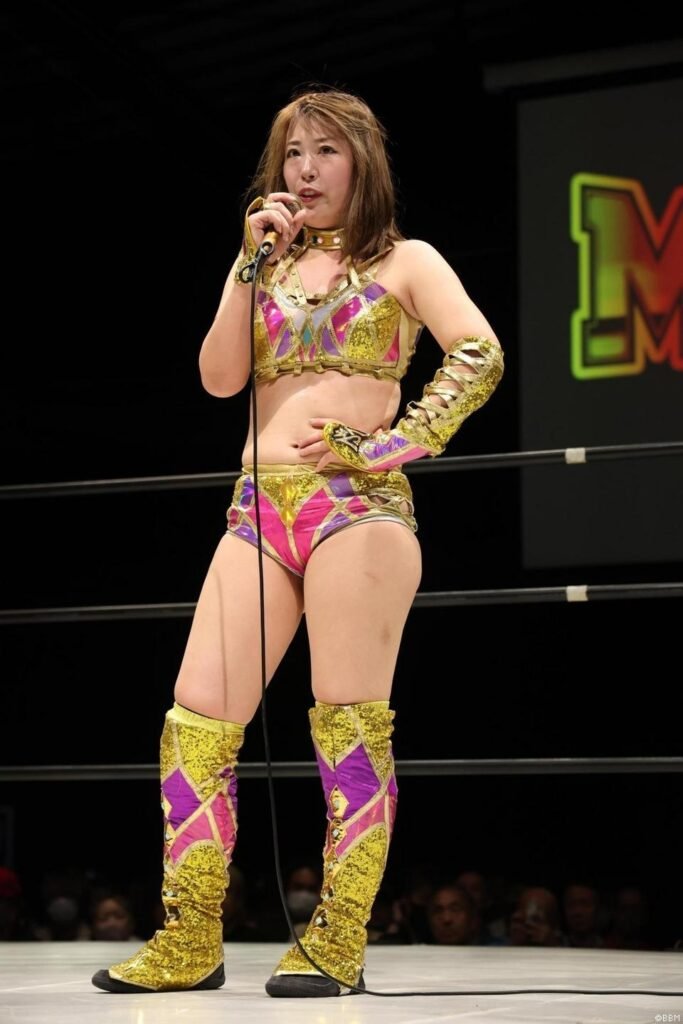
Confession of the Super Lady
Mai Sakurai, the “Storm-Calling Super Lady,” has announced her departure from Marigold. Her final match as a roster member is set for October 24 at Ryogoku Kokugikan. Since Marigold’s inaugural event in May 2024, she has supported the promotion with her spirited fighting style, but since the start of this year, a string of frustrating results has left her in tears more and more often. Between her selfless devotion despite being battered from head to toe and a growing disconnect between the pro wrestling she aspired to and those around her, her body and mind reached their limits. Hiroki Matsukawa of Weekly Pro Wrestling magazine spoke with Sakurai about her decision to leave the promotion.
――You have decided to leave Marigold, the promotion where you have fought since its launch.
Mai Sakurai: My desire to keep giving my all in Marigold was unwavering. However, as wrestlers left one by one, my position and what was expected of me gradually changed to fill those gaps, and I feel like I pushed myself too hard. Deep down, I was overextending myself. I realized it wasn’t healthy to keep going in this state and felt I needed to rest for a bit, which led me to this decision.
――You chose to leave the promotion rather than take an extended hiatus.
Mai Sakurai: I turned 36 this year. This might sound dramatic, but when I thought about how much of my pro wrestling career I have left, I realized that time spent resting is also incredibly precious—and if I were simply out on hiatus, I know I would start feeling anxious and rushed to return. That’s why I want to come to a full stop and hit reset. I wanted to draw a clear line and face myself at my own pace.
――Since the beginning of this year, we have seen you agonize and shed tears many times.
Mai Sakurai: That’s true… The biggest turning point was January 3 of this year. Honestly, I was really down on myself. I suffered a cervical sprain and also developed stress-induced gastroenteritis. Because I would throw up whenever I ate solid food, there was a period where I could only get nutrition through an IV drip.
――It is impossible to forget the sight of you crying in frustration after that match.
Mai Sakurai: I had finally made it all the way to a challenge for the Red Belt, and even though I was completely fired up to compete in the main event of a big show, I felt the frustration of my body not being able to keep up. I was probably pushing myself too hard in a lot of ways. On that day, I couldn’t showcase my strengths at all, and it felt as though everything I had built up to that point had come crashing down all at once. That is precisely why I put so much into this year’s league tournament as a chance at redemption for January 3. I always believed that following through on my word was who I am.
――You promised the fans that you would win the DSGP this year for sure.
Mai Sakurai: Yes. I wanted to show them a dream.
――In the end, you weren’t able to fulfill that dream, and now you are leaving Marigold—the place where you once said you would lay your bones to rest.
Mai Sakurai: That’s right, because I genuinely intended to retire in Marigold.
――So the situation had reached a point where even that resolve changed?
Mai Sakurai: It’s hard to put into words, but… right now, I truly just want to rest my body and my mind. That is how I honestly feel.
――The October 24 Ryogoku show will be your final match as a roster member.
Mai Sakurai: I am truly sorry that this announcement came so suddenly.
――You mentioned that you want to fight brightly and in true Mai Sakurai fashion until the very end.
Mai Sakurai: Yes. My desire to work for the sake of Marigold hasn’t changed one bit since the inaugural show. Even having made this decision, I want to keep contributing right up until the very end so that everyone can enjoy it.
――Do you have any wishes for your final match card?
Mai Sakurai: The person I’ve always looked out for is Shin-chan (Shinno). Other than her, I’d say the members of La Vie en Rose are the ones I want to be involved with at the end.
――What about your plans after leaving the promotion?
Mai Sakurai: No matter what decision I eventually make, I want to take a break first to refresh myself, and then think about what path to choose while listening to my heart at that time.
――Please share a message for the fans.
Mai Sakurai: I have nothing but gratitude for all the fans who have supported Marigold’s Mai Sakurai over the past two and a half years. I will be leaving Marigold following the Ryogoku Kokugikan event on October 24. Without forgetting my gratitude for being able to have once-in-a-lifetime experiences here, I want to rest for a little while and then look forward again. Thank you very much for everything.
Translation Notes:
- “Storm-Calling Super Lady” (Arashi wo Yobu Chokifujin) & “Confession of the Super Lady” (Chokifujin no Kokuhaku):
- In the introductory text and main headline, Mai Sakurai is referred to by her signature moniker Chokifujin (超貴婦人), which literally translates to “Super Lady” or “Ultra-Aristocrat”.
- It is prefaced by the classic dramatic Japanese showbiz epithet Arashi wo Yobu (嵐を呼ぶ — “Storm-Calling” or “Storm-Bringing”).
- The main feature title, Chokifujin no Kokuhaku (“Confession of the Super Lady”), deliberately contrasts her haughty, untouchable high-society ring persona with the raw, vulnerable honesty of her departure announcement.
- Departure (Taidan) vs. Hiatus (Ketsujo) & Affiliated Roster Status (Shozoku):
- The interviewer draws a sharp distinction between ketsujo (欠場 — taking an extended medical or personal leave of absence while remaining under contract) and taidan (退団 — officially resigning and leaving a promotion’s roster).
- Throughout the article, Sakurai’s October 24 bout at Ryogoku Kokugikan is described as her shozoku rasuto matchi (所属ラストマッチ — “final match as an affiliated/contracted roster member”). By choosing taidan over ketsujo, Sakurai frees herself from the psychological pressure and guilt of occupying a roster spot while recovering, allowing her to step away without a ticking clock forcing a premature return.
- “Battered from head to toe” (Manshin Soui) & “Disconnect with those around her” (Shuui to no zure):
- The introductory summary uses the four-character idiom manshin soui (満身創痍), which literally means “covered in wounds across one’s entire body” and describes an athlete competing while completely battered and broken down.
- The journalist also notes a growing zure (ズレ — a gap, friction, or misalignment) between the style and vision of pro wrestling Sakurai aspired to and those around her.
- In her opening answer, Sakurai contextualizes this pressure by noting that as wrestlers departed the promotion one by one (senshu ga hitori zutsu nukete itte), her own standing (tachiba) and the expectations placed on her shoulders shifted to fill those voids, leading her to push past her physical and mental limits (muri ga atta).
- January 3 (1・3), The “Red Belt” (Akai Beruto), and Medical Struggles:
- In Japanese puroresu journalism, major events are routinely referenced in shorthand by their month and day separated by a middle dot—here, 1・3 (January 3), 10・3 (the October 3 Toyonaka event where she announced her departure), and 10・24 (the upcoming October 24 Ryogoku Kokugikan major show).
- Sakurai points to January 3 of this year—where she headlined a major show in a challenge for the Akai Beruto (赤いベルト — “Red Belt,” the universal nickname for the crimson-strapped top singles title in Rossy Ogawa-promoted women’s wrestling)—as the moment her confidence shattered.
- She reveals two severe medical conditions that plagued her around that time: keitsui nenza (頸椎捻挫 — a cervical sprain / severe neck whiplash) and sutoresu-sei ichouen (ストレス性胃腸炎 — stress-induced gastroenteritis), the latter of which caused her to vomit solid food and forced her to rely on intravenous drips (tenteki) just to take in nutrition.
- DSGP & “Revenge” (Ribenji) in the League Tournament:
- DSGP is the official abbreviation for the Dream Star Grand Prix, Marigold’s premier annual round-robin singles tournament, which Sakurai refers to as “this year’s league tournament” (kotoshi no riigu-sen).
- When Sakurai says she entered the tournament for ribenji (リベンジ — a loanword from the English “revenge”), in Japanese sports terminology it specifically means “redemption” or “avenging a past failure/loss” rather than personal malice—referring to her desire to redeem her disappointing January 3 main event performance and make good on her public promise to the fans.
- “Laying one’s bones to rest” (Hone wo umeru):
- The interviewer notes that Sakurai had previously vowed to hone wo umeru (骨を埋める) in Marigold. Literally meaning “to bury one’s bones,” this is a traditional Japanese idiom signifying a vow of lifelong dedication to a company, organization, or place, with the full intention of staying there until retirement (intai) or death.
- Shin-chan (Shinno), La Vie en Rose,, and Mad EGO:
- Shin-chan (Shinno): In the interview text, Sakurai affectionately refers to rookie Shinno (心希) as “Shin-chan” (心ちゃん), using the endearing diminutive suffix -chan along with the first character of her name, while the magazine adds “(Shinno)” in parentheses for reader clarity. This reflects their close mentor-protégé bond, which is echoed in the bottom-right caption noting that Shinno “adores/looks up to Sakurai” (Sakurai wo shitau Shinno).
- La Vie en Rose (ラビアンローズ): Named after the famous French phrase meaning “Life in Pink,” this is Sakurai’s aristocratic faction/unit in Marigold, whose members she hopes to face or team with in her final match.
- Mad EGO (狂EGO): The tag team name of Yuuka Yamazaki and Shinno. In the original Japanese text, it is stylized as Kyo EGO (狂EGO), combining the kanji Kyo (狂 — madness, frenzy, or lunacy) with the English word “EGO”.