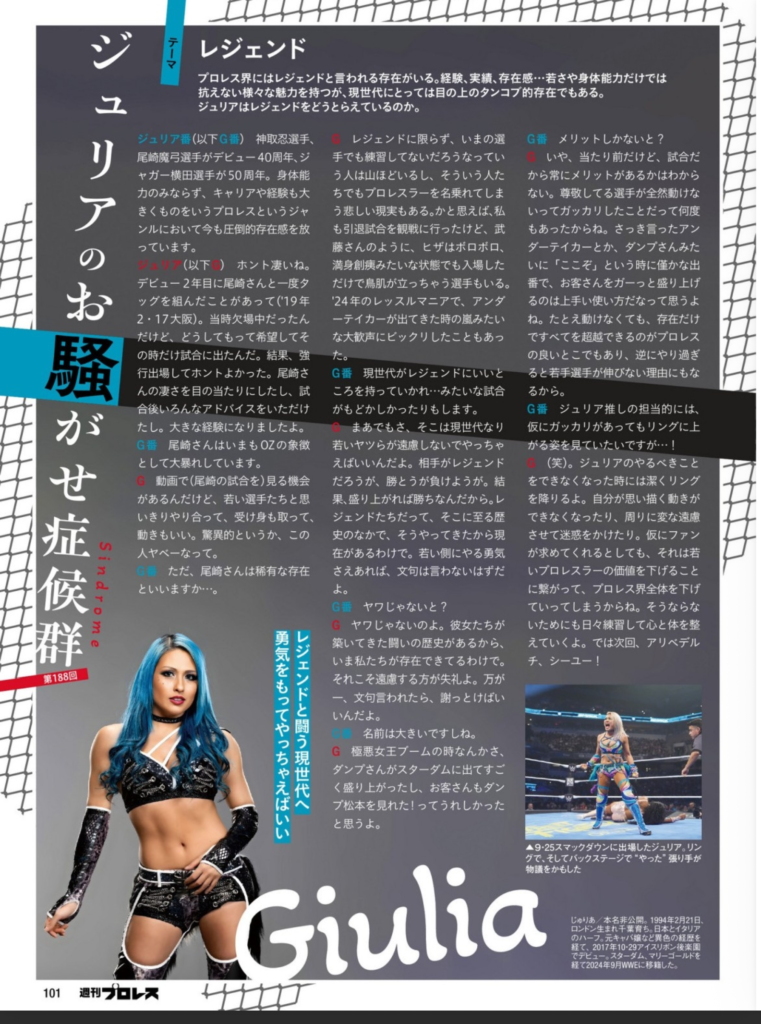
In the pro-wrestling world, there are those known as “legends.” They possess various charms—experience, achievements, presence—that cannot be rivaled by youth or physical ability alone. Yet, to the current generation, they can also be a thorn in their side. How does Giulia view these legends?
G: Shinobu Kandori and Mayumi Ozaki are celebrating their 40th anniversaries since their debuts, and Jaguar Yokota is celebrating her 50th. In a genre like pro-wrestling, where not just physical ability but career and experience speak volumes, they continue to exude an overwhelming presence.
Giulia: It’s truly amazing. In my second year after debuting, I got to team with Ozaki once (Feb 17, 2019, in Osaka). I was actually out with an injury at the time, but I practically begged them to let me wrestle just that one match. Looking back, pushing myself to compete was absolutely the right call. I witnessed Ozaki’s greatness firsthand and received a lot of advice from her after the match. It was a massive learning experience for me.
G: Ozaki is still running wild today as the symbol of OZ.
Giulia: I sometimes get the chance to watch videos of her matches. She goes all out against the younger wrestlers, takes her bumps, and moves so well. It’s phenomenal—honestly, it makes me think, “This woman is insane.”
G: But you could say someone like Ozaki is a rare exception…
Giulia: It’s not just limited to legends; there are tons of current wrestlers where you can clearly tell, “They probably don’t practice,” and the sad reality is that even people like that get to call themselves pro-wrestlers. On the flip side, there are wrestlers like Muto—I went to watch his retirement match—where his knees were completely shot, his entire body was battered, yet just his entrance alone gave you goosebumps. I was also blown away by the deafening, storm-like pop the Undertaker got when he appeared at WrestleMania ’24.
G: It can also be frustrating to watch matches where the current generation gets totally upstaged by the legends.
Giulia: Well, you know, that’s where the current generation, the young kids, just need to stop holding back and go for it. Regardless of whether their opponent is a legend, or whether they win or lose. In the end, if the crowd goes wild, that’s a win. The legends themselves only got to where they are today because they did the exact same thing throughout their history. As long as the younger side has the guts to bring the fight, the veterans aren’t going to complain.
G: Because they aren’t fragile?
Giulia: They definitely aren’t fragile! The only reason we can exist right now is because of the history of battles they built up. Holding back is honestly more disrespectful. And hey, on the off chance they do complain, you can just apologize later.
G: Their name value is huge, isn’t it?
Giulia: Take the Queen of Villains boom, for example. Dump Matsumoto made an appearance in Stardom, and the crowd went absolutely crazy. I think the fans were just genuinely thrilled to be able to say, “We got to see Dump Matsumoto!”
G: So, would you say there are only merits to using them?
Giulia: No, of course not, it’s a match, so you never know if it’s always going to be beneficial. There have been plenty of times I’ve been disappointed seeing a wrestler I respect completely unable to move. I think the smartest way to utilize them is like what I mentioned earlier with the Undertaker or Dump Matsumoto—having them make brief, high-impact appearances right when it counts to instantly fire up the crowd. Even if they can’t move much anymore, the fact that their mere presence transcends everything is one of the beautiful things about pro-wrestling. But, on the flip side, overdoing it can become the exact reason why young wrestlers fail to grow.
G: As the interviewer—and a huge Giulia fan—I’d want to keep seeing you step into the ring, even if it meant risking that disappointment!
Giulia: (Laughs). Whenever I can no longer do what Giulia is supposed to do, I’ll gracefully step away from the ring. Like, if I can’t execute the movements I envision, or if I start causing trouble by making the people around me awkwardly hold back. Even if the fans still wanted me, doing that would ultimately devalue the younger wrestlers, which drags down the entire pro-wrestling industry. To make sure that doesn’t happen, I’ll keep practicing every day to keep my mind and body in top shape. Until next time, arrivederci, see you!
Translation Notes:
- “Thorn in their side” (目の上のタンコブ – Me no ue no tankobu): A Japanese idiom that literally translates to “a lump above the eye.” It is used to describe an annoying superior, an obstacle, or someone whose presence is a constant nuisance or hindrance to one’s own advancement.
- Queen of Villains (極悪女王 – Gokuaku Joou): Refers to the 2024 hit Japanese Netflix biographical drama about the life of Dump Matsumoto. The massive mainstream success of the show triggered a renewed cultural interest in joshi puroresu, leading to Matsumoto’s real-life special appearance in Stardom.
- Arrivederci (アリベデルチ): Italian for “goodbye.” Giulia frequently uses this as her signature sign-off catchphrase, proudly leaning into her half-Italian heritage.
- Cabaret club hostess (キャバ嬢 – Kyaba-jou): A common profession in Japanese nightlife where women entertain customers through conversation and serving drinks. Giulia has historically been very open about her time working in the industry prior to becoming a wrestler.