September 16, 2026
The first time I ever watched professional wrestling live in the Tokyo metropolitan area was on June 2, 1983, at the Kuramae Kokugikan for the finals of the 1st IWGP Tournament (Hulk Hogan vs. Antonio Inoki). Kuramae, which was already quite dilapidated at that point, ended its history and was demolished the following year.
In the 43 years since, I have experienced farewells with many venues other than Kuramae. In the Tokyo area alone, there was the Denen Coliseum, the Tokyo Metropolitan Gymnasium, Tokyo Bay NK Hall, Ota Ward Gymnasium, Yokohama Cultural Gymnasium, and Differ Ariake. Out in the regions, the Sapporo Nakajima Sports Center and Hakata Star Lanes also reside in the depths of nostalgic memory. And now, with its final event on the 30th of this month, Shinjuku FACE will close its doors.
Shinjuku FACE opened in 2005 as the fourth permanent wrestling ring venue in Tokyo, following Differ Ariake, Battle Sphere Tokyo, and Shin-Kiba 1st RING. In addition to its prime location right in the middle of Shinjuku’s Kabukicho district, it boasted comprehensive sound and lighting equipment and an ideal capacity of about 500 when packed to the rafters. Because of this, countless wrestling promotions have used it to carve out their history.
In particular, it was a venue I frequented often, largely because it was heavily utilized by women’s and indie promotions—which fall squarely into my coverage beat. Some promotions, like BASARA and SMASH, held their inaugural events here, while for others, like Battlarts, it served as their final resting place.
Many women’s promotions have utilized the venue as well, but none had a deeper connection to it than Oz Academy. For OZ, which has held shows in this building almost every single month since launching as an independent promotion at the end of 2005, it is truly their home ground. However, OZ’s relationship with that location actually began nine years before Shinjuku FACE even opened.
In 1996, OZ was formed as a unit led by JWP’s Mayumi Ozaki—who acted as the “principal” (since it was an “Academy”). They held their very first shuzai kogyo on December 8 of that year. It’s an unfamiliar term, but to put it simply, it was a JWP spin-off event with OZ as the main focus. The stage for that show was the live music club Liquidroom, which was operating in the exact same space where FACE is today.
That was the first time a professional wrestling event had ever been held at that venue. In other words, although the name of the venue was different, the history of professional wrestling in that specific space was inaugurated by OZ.
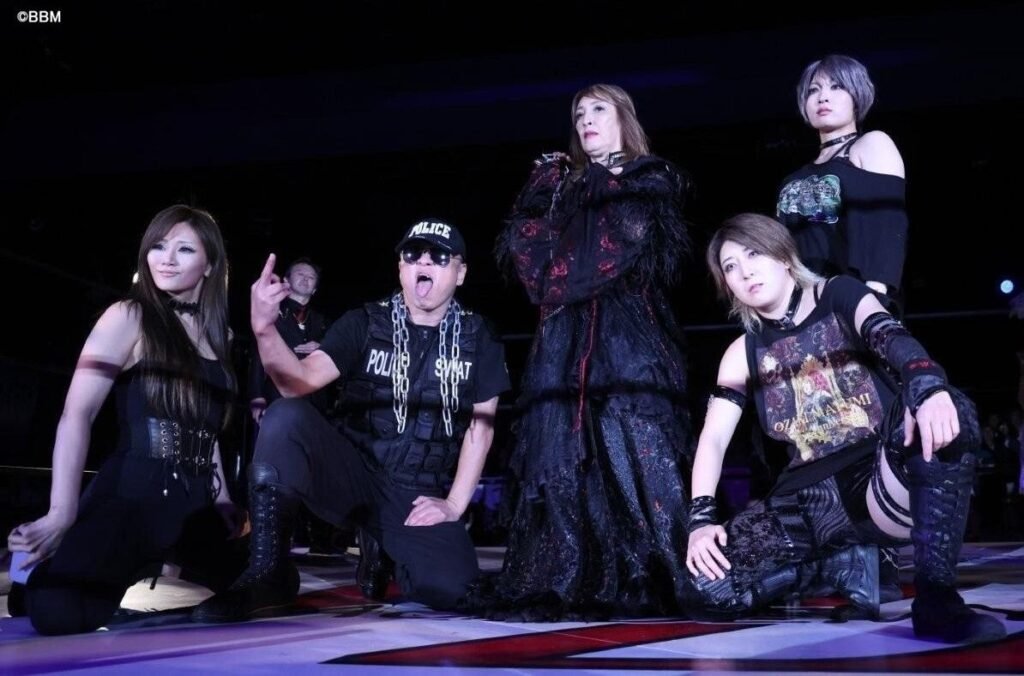
OZ held their final FACE event on the 13th. With the venue’s closure looming, various promotions are hosting their last shows there this month, but OZ’s event—given their strong bond with the building—felt distinctly different from the rest.
The main event was the first—and likely the last—singles encounter between Ozaki and Natsupoi. Perhaps due to the overlap of such rare circumstances, Police made a long-awaited appearance in Ozaki’s corner, running wild and wreaking thirty percent more havoc than usual. Ozaki beat Natsupoi half to death, but in the end, she suffered an upset loss via Fairy Magic (a triple-rotation La Magistral) following an accidental friendly-fire spot.
For Ozaki, however, this match was not her Shinjuku FACE swan song. In the main event of the venue’s true final show on the 30th, Ozaki will form a first-time tag team with Sareee to face Aja Kong and Chihiro Hashimoto.
The other three participants in this match are also wrestlers with deep ties to FACE. Hashimoto and Sareee both share the bitter experience of losing singles titles to Aja in this very venue. Including the team dynamics, it is a gorgeous and groundbreaking card perfectly fitting for the end of an era. Furthermore, Ozaki competing in this match creates another significant layer of meaning.
During the aforementioned 1996 Oz Academy event, Ozaki wrestled in all four matches on the card, which naturally meant she competed in the opening bout as well. In short, the history of professional wrestling that has unfolded on the 7th floor of the Humax Pavilion in Shinjuku’s Kabukicho—from Liquidroom to Shinjuku FACE—began with Mayumi Ozaki, and it is about to end with Mayumi Ozaki.
Considering that nearly 30 years have passed and thousands of matches have been held in that span, this is nothing short of a miracle. That said, the first-time duo of Ozaki and Sareee is a pairing that could very well fall apart mid-match. Moreover, their opponents are the powerhouse team of Aja and Hashimoto.
Whose victory, and whose defeat, will ultimately draw the curtain on the history of Shinjuku FACE?
Translator’s Notes:
- Shuzai Kogyo (主在興行): This translates literally to something akin to “primarily hosted event.” Suyama points out it is an uncommon phrase; it was JWP’s specific internal terminology for a sub-brand or spin-off event that put a specific stable (in this case, OZ) in the starring roles.
- Liquidroom / Humax Pavilion: The Liquidroom was an iconic live music club situated on the 7th floor of the Humax Pavilion in Kabukicho. In 2004, the Liquidroom relocated to Ebisu, and the vacated space was repurposed to open Shinjuku FACE in 2005.
- Kuramae Kokugikan: A famous indoor arena in Tokyo built primarily for sumo. It hosted the inaugural IWGP final where Hulk Hogan famously knocked out Antonio Inoki. It was closed in 1984 and succeeded by the current Ryogoku Kokugikan.
- Police: Mayumi Ozaki’s infamous, long-tenured heel manager/second who frequently interferes in her matches wielding weapons like chains or batons.
- Fairy Magic: Natsupoi’s signature pinning combination, effectively a fast-paced, triple-rotation La Magistral cradle.