September 23, 2026
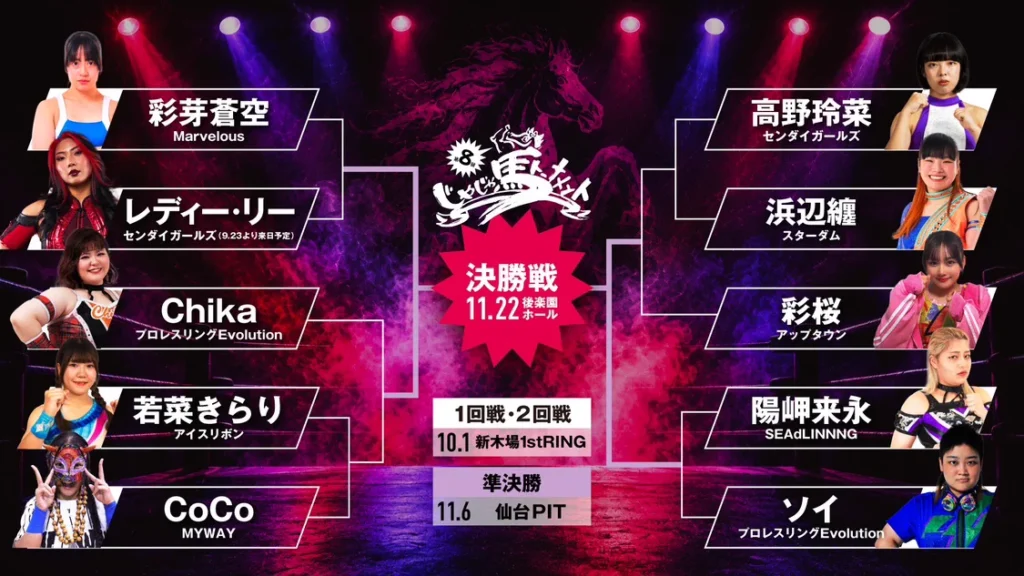
“Ooh, nice!” I cheered, only to feel crushed a few days later with an “Oh dear…” A few hours after that, I caught myself grinning, thinking, “Wait, this might actually make things interesting.” Fast-forward a few days to the bracket announcement, and my hype has peaked. Man, this year’s Jajauma Tournament has had my emotions on an absolute rollercoaster, and it hasn’t even started yet.
The Jajauma Tournament—a competition for rookies and young prospects with less than three years of experience (as of the tournament’s announcement)—is celebrating its 8th edition this year. Incidentally, the only wrestler from the host promotion, Sendai Girls’ Pro Wrestling (hereafter “Senjo”), to ever win it was Sachiko Sendai back in the second tournament. That’s because the vast majority of the field comes from outside promotions, and on top of that, representative Meiko Satomura mercilessly scouts the toughest competitors she can find.
This year, in particular, features a thrilling lineup. That “Ooh, nice!” at the beginning of the column was my initial reaction when I first saw the names of the ten participants listed below:
Reina Takano (Sendai Girls’ Pro Wrestling), Sora Ayame (Marvelous), Rana Hisaki (SEAdLINNNG), Kirari Wakana (Ice Ribbon), Chika (Evolution), Matoi Hamabe (Stardom), CoCo (MYWAY), Saira (Uptown), Miku Kanae (T-HEARTS), and Lady Leigh.
Aside from Lady Leigh, who is making her first tour from America, this field is entirely made up of rookies and young prospects. Because of that, there are naturally many unfamiliar names, and some readers might find it hard to understand my initial “Ooh!” reaction. Ideally, I’d love to break down the backgrounds of all nine other competitors in detail, but there’s simply no way it would fit within the word count of a single column, and it’s absolutely agonizing that we’ll hit the opening night a week from this Thursday before I get the chance.
Well then, when I went out on the beat after the participant announcements, the general consensus I heard from various wrestlers and industry insiders regarding this year’s lineup went something like this:
“It’s a really interesting group they’ve put together, but I’m especially excited that both CoCo and Saira are in it.”
Saira is an active high school student who debuted in May of this year. She is a phenomenal athlete who has even medaled in a national parkour tournament (which, to put it crudely, is a flashy obstacle course). CoCo, who just graduated middle school this spring, comes from a wrestling family—both her father and older brother are pros. While her career has technically surpassed the three-year mark, she was granted special exemption to enter since she debuted as a first-year middle school student.
Both are high-flyers who specialize in high-difficulty aerial maneuvers. On top of that, they have a remarkably high aptitude for pro wrestling; practically without exception, wrestlers who have either fought them or watched them perform call them geniuses. Furthermore, Saira (with less than half a year since her debut) and CoCo (whose home promotion is based in Fukuoka) have both had very few singles matches against wrestlers of their own generation. Ironically, this lack of peer-to-peer matchups is a major reason why their entry into this tournament is drawing so much attention within the industry.
Another type of genius—or rather, someone who was already formidable the moment she stepped into pro wrestling—is Chika. To begin with, her billed 100-kilogram frame is an extraordinary gift in itself, but her martial arts pedigree prior to turning pro is staggering. She actually competed in the Kodokan Cup All-Japan Judo Weight Class Championships. While plenty of joshi wrestlers have judo experience, she is the only wrestler to debut in the 21st century who has competed at the senior All-Japan level.
However, the one heavy favorite predicted to trump all those prodigies was Miku Kanae. Despite her small stature, she has competed across a wide variety of promotions, and her total match count since her debut stands head and shoulders above the rest of the field. In a tournament restricted to those with less than three years of experience, the sheer volume of experience she has accumulated should have been a massive advantage…
Unfortunately, Miku suffered a torn anterior cruciate ligament (ACL) in her knee, forcing her into a long-term absence and ruling her out of the Jajauma Tournament. When I heard the news of her injury, the “Oh dear…” mentioned at the beginning of this column just slipped out.
Chosen to replace Miku in the bracket is Evolution’s Soy. Boasting a sturdy 80-kilogram frame second only to Chika among the entrants, she, like Miku, has racked up plenty of experience competing in outside promotions and possesses more than enough skill to make a run at the championship.
Of course, the wrestlers I wasn’t able to mention by name in this column are also fired up, carrying the pride of their respective promotions on their backs. Since it’s a single-elimination tournament, it wouldn’t be a surprise to see any of them advance.
When the finals take place at the November 22nd Korakuen Hall show, who will be the lone undefeated competitor to claim the crown of champion? Just writing about it has made me look forward to it even more.
Translation Notes & Cultural Context
- Jajauma (じゃじゃ馬): The title of the tournament literally translates to “unmanageable horse” or “wild horse.” In Japanese, it is a common idiom used to describe a fiercely independent tomboy, a spitfire, or someone who refuses to be tamed—a perfect namesake for a tournament showcasing hungry, unpolished rookies fighting to make a name for themselves.
- Senjo (仙女): The colloquial abbreviation for Sendai Girls’ Pro Wrestling. It combines the first kanji of Sendai (仙) with the kanji for woman (女).
- Parkour / Obstacle Course: In the original text, Suyama humorously dumbs down “parkour” as a “flashy obstacle course” for the benefit of older, traditional wrestling fans reading the magazine who might not be familiar with modern urban sports. (Note: The original Japanese text contains a slight typo, spelling it バルクール [Barukuru] instead of the correct パルクール [Parukuru]).
- Kodokan Cup All-Japan Judo Weight Class Championships: This is one of the most prestigious, highest-tier judo tournaments in Japan, serving as a primary qualifier for the national Olympic and World Championship teams. Suyama emphasizes this to show that Chika isn’t just a former high school judoka; she competed at the absolute elite senior level before transitioning to pro wrestling.
- Korakuen Hall: Mentioned in the final paragraph, Korakuen Hall in Tokyo is widely considered the “Mecca” of Japanese combat sports. Holding a tournament final in this historic venue adds immense prestige to the rookie event.