MIRAI’s Tamakome Friday Column | Installment No. 13 | November 27, 2026
Translated from Japanese for Archival & Critical Preservation
I’m Starting “MIRAI Taiso”!
¡Hola a todos!
Everyone, Friday has arrived! ( * ॑꒳ ॑*)
One of the things I’ve been wanting to do has finally begun! Its name is “MIRAI Taiso”!
Archival Dossier
- Column: MIRAI’s Tamakome Friday Column (No. 13), published November 27, 2026. “Tamakome” (たまこめ) is MIRAI’s contraction of her catchphrase tamashii komete (魂込めて, “putting my soul into it”).
- Program: MIRAI Taiso (MIRAI体操), a children’s calisthenics, mat exercise, and physical conditioning initiative devised by MIRAI as a playful counterpart to Jinsei Shinzaki’s senior-focused Jinsei Taiso.
- Launch Venue: Omoe Elementary School (Omoe Shogakko) in Miyako, Iwate Prefecture, MIRAI’s alma mater, celebrating its 150th anniversary.
- Inaugural Format: Three full class periods split across 1st and 2nd graders, 3rd and 4th graders, and 5th and 6th graders, covering mat work, snow-safe ukemi, and basic conditioning alongside Ringo Yamaya.
Jinsei Shinzaki created “Jinsei Taiso,” a bodyweight training and health exercise program aimed at exercise beginners, middle-aged adults, and seniors to help extend their healthy life expectancy. To rival that!? Devised by yours truly, “MIRAI Taiso,” an initiative that teaches children calisthenics, mat exercises, and physical training, has officially launched!! “(ノ*>∀<)ノ
Taiso (体操, structured calisthenics and physical exercises): Familiar across Japan through daily Radio Taiso broadcasts, the term covers general gymnastics and group conditioning. Both “Jinsei Taiso” and “MIRAI Taiso” retain “Taiso” as proper program names, preserving Jinsei Shinzaki’s ring name rather than translating jinsei literally as “life.” MIRAI also writes watakushi (ワタクシ, “yours truly”) in katakana for mock-grand comedic effect when framing her friendly rivalry with Shinzaki.
During the period when I ended up thinking about retiring from pro wrestling, one of the things that came to mind when I asked myself, “Is there anything I’ve left undone?” was becoming a bridge between Iwate and pro wrestling, two things that I love. I am so happy to really feel that I am making that a reality through initiatives like this.
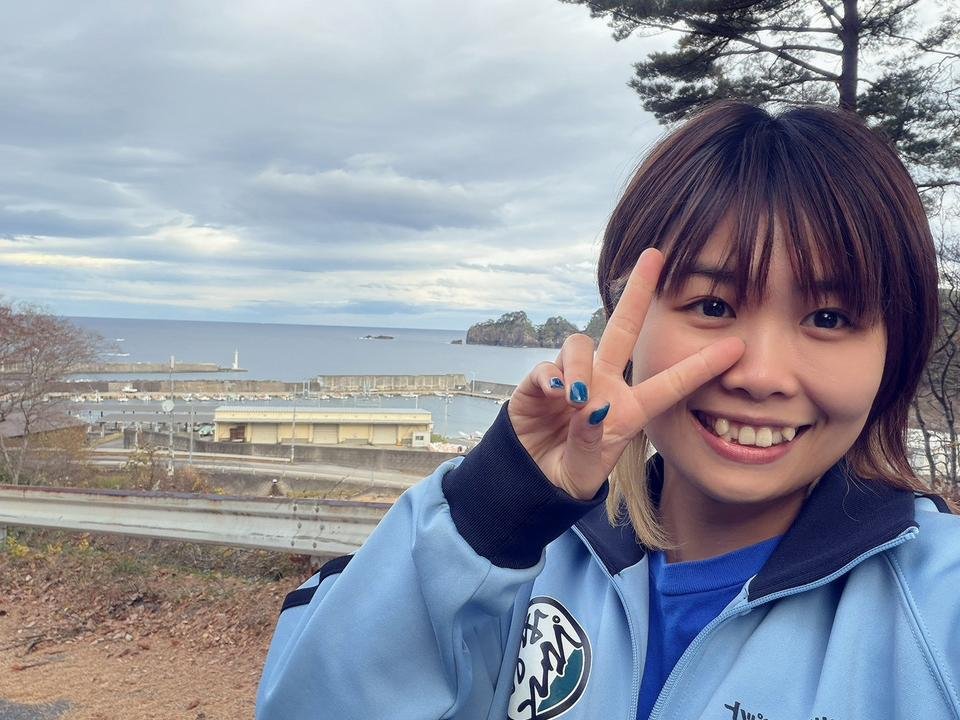
I had already been wanting to do things like elementary school visits and was in the process of making arrangements, when during a courtesy visit to the Mayor of Miyako, the mayor suggested, “Why don’t you do ‘MIRAI Taiso’?” Right at that exact time, it turned out my alma mater, Omoe Elementary School, was celebrating its 150th anniversary. They reached out and asked, “Would you be able to do something for us?” So I was able to get what I wanted to do off to a wonderful start in a place I love. Honestly, it feels like time for a dance of joy ( ◜ω◝و(و “!!
Omoe Elementary School (重茂小学校) and Miyako (宮古): Miyako is a coastal city in Iwate Prefecture. The school’s kanji carries the irregular local place-name reading Omoe (Omoe Shogakko), located on Iwate’s Omoe Peninsula.
As for the program contents, they are:
- Warm-up exercises
- Mat exercises
- Ukemi (breakfalls)
- Basic physical conditioning
- Cool-down
From what I hear, nowadays fewer schools are teaching mat exercises. With regulations becoming stricter in the Reiwa era, I wonder if it has become a habit to eliminate anything that carries a risk of injury… We pro wrestlers thoroughly understand the mechanics, and we also have the strength to spot and assist them. We can teach mat exercises properly and safely.
Reiwa Era (令和): Japan’s current imperial era, which began in May 2019. MIRAI uses it conversationally to contrast contemporary school safety policies with earlier eras when gymnastics and mat exercises were standard parts of physical education.
As for ukemi, pro-wrestling-style ukemi is too difficult for them to do, but especially in Iwate, we are heading into the season when it’s easy to slip and fall on the snow. So I teach them simple ukemi to help keep them from hitting their heads if they fall.
Ukemi (受け身, breakfalls): Foundational martial arts and pro wrestling falling technique used to absorb impact and protect the head and neck. Here MIRAI adapts the basic chin-tucking habit for children walking on icy Iwate roads.
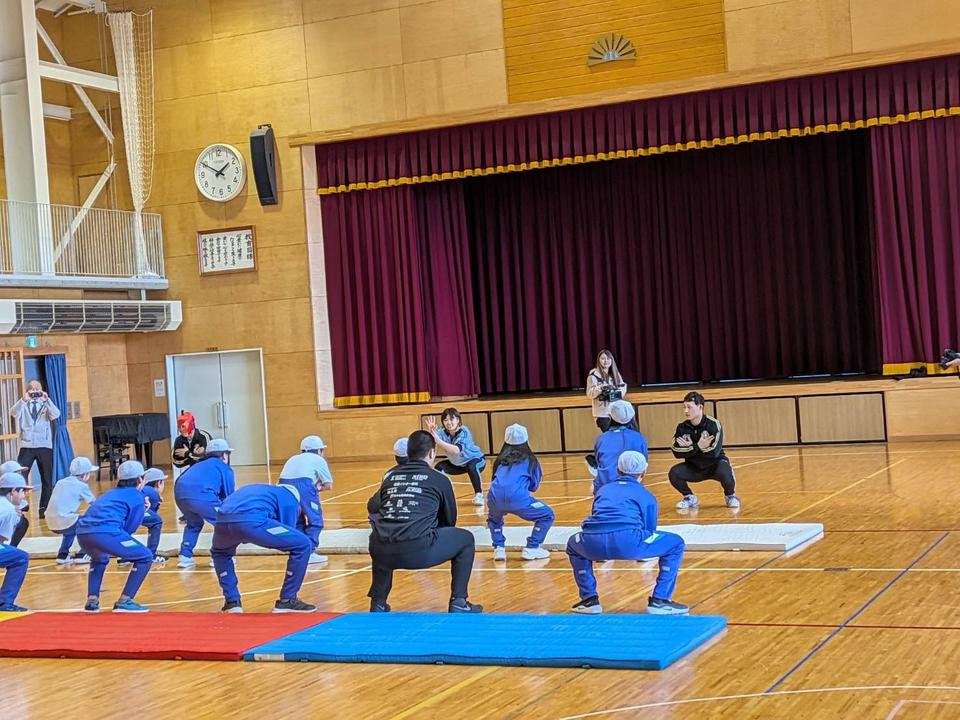
For basic physical conditioning, it’s not the kind of routine or rep count that pro wrestlers do every day, but we do simple yet effective squats and other exercises that Jinsei-san taught me, like the ones done in Jinsei Taiso.
At Omoe Elementary School, covering items 2, 3, and 4, I divided the students into 1st and 2nd graders, 3rd and 4th graders, and 5th and 6th graders, and had the opportunity to teach three full class periods of exercises!
Having actually taught the classes, first and foremost, elementary school kids are way too cute (*´д`*)♡ During the 1st and 2nd grade session, when their homeroom teacher said, “We’re going to play tag!” as a warm-up, their reaction was a chorus of “Yaaay!!” just like Minions! They were genuinely so cute, my heart melted ♡♡ That said, Ringo was so popular that I got a little jealous ( ⸝⸝>⤚<) (laughs)
Ringo (林檎選手): Refers to Ringo Yamaya, whose ring name uses the kanji for “apple” (林檎). Because MIRAI mentions her solely by given name without specifying her exact duties during the school visit, the text leaves her role unstated.
With the lower grades, they didn’t yet have much strength to tuck their chins and protect their heads during ukemi, and as the grades went up, the gap widened in what different kids were able to do. There were also plenty of things I learned from actually teaching them. Moving forward, I want to hold MIRAI Taiso in all kinds of places so it won’t lose out to Jinsei Taiso! Interacting with these diamonds in the rough who have bright futures ahead of them is truly precious and the absolute best time! I draw inspiration from all of them, and I would be happy if I can give them even a tiny bit of inspiration in return!
Alongside pro wrestling, of course, I plan to keep actively doing more and more initiatives like this going forward, centered around Iwate! Thank you for your continued support! (*ˊ ˋ*)
Well then, please be sure to read again next week! ´ω`)ノ
Iwate Dialect Sign-off (んでば、来週も読んでけどがんせ~): Ndeba (んでば) is Tohoku and Iwate dialect equivalent to soredewa (“well then”), and -kedoganse (〜けどがんせ) is a warm Miyako-area polite request equivalent to -te kudasai (“please do…”).