September 3, 2026
The traditional touring model in Japanese women’s professional wrestling is being put on notice. We are no longer living in an era where promoters can just paper the calendar with dates, open the doors, and expect a healthy gate on brand loyalty alone. The business is fundamentally changing, and the data backs it up.
According to the latest bimonthly report from Joshi Puroresu News, the ceiling for the market is absolutely rising—but only for the players who understand that modern growth is entirely event-driven.
The report drops a crucial reality check on the state of the industry: “The summer therefore looks less like industry-wide expansion than growth concentrated around promotions and events capable of creating a stronger proposition for the consumer.”
In short: you have to manufacture a moment, or you’re just spinning your wheels.
Stardom’s Touring Engine
Look no further than Stardom. They aren’t just the market leaders; they are operating a different sport entirely. The 5★STAR GP wasn’t merely a creative exercise; it functioned as a calculated, escalating commercial engine. They built momentum block by block, transitioning from 500-seat regional buildings to a massive, sold-out Ryogoku Kokugikan crowd of 5,004. Factor in the dual-platform monetization of Stardom World and StageCrowd, and Stardom is proving they can double-dip on both the physical live gate and the international digital dollar.
Marigold and TJPW: Scaling and Crossover
Dream Star Fighting Marigold is making its own calculated leaps. Drawing 1,310 to Ota Ward for Summer Destiny proves they have the structural capacity to step out of Korakuen Hall when the marquee demands it. However, from a business standpoint, their real challenge isn’t just one big gate—it’s establishing a reliable developmental pipeline so they don’t have to rely solely on established veterans to draw the house.
Tokyo Joshi Pro-Wrestling (TJPW) took the most fascinating commercial gamble of the summer. By fusing the Tokyo Princess Cup with the Tokyo Idol Festival, they parked their product directly in front of a massive, non-traditional youth demographic. Leveraging free YouTube exposure alongside their Wrestle Universe subscriptions isn’t just booking a show; it’s an aggressive customer acquisition strategy.
The Power of the Freelancer Economy: Marvelous and Sendai Girls
You don’t need a corporate behemoth’s budget to spike your numbers. You just need the right creative equity.
Sendai Girls leveraged their 20th-anniversary branding to step out of their regional footprint, selling out Yoyogi 2nd Gymnasium by relying on the bulletproof drawing power of Chihiro Hashimoto.
Then there is Marvelous That’s Women Pro Wrestling, which provides the most fascinating case study in operational efficiency. Marvelous operates on a comparatively small regular live business footprint, and their day-to-day gates shouldn’t be judged against the massive 3,500 peak of their Yokohama Buntai anniversary show. What Marvelous does better than anyone is exploit the modern freelancer economy. By building high-stakes, cross-promotional narratives—like the Spark Rush program involving Sareee and Takumi Iroha colliding with Mio Momono and Senka Akatsuki—they manufacture commercial storytelling that feels significantly larger than their venue base. Marvelous proves that you don’t need the massive overhead of a permanent, sprawling roster to generate industry buzz; you just need to know how to book the talent that moves the needle across company lines.
The Numbers
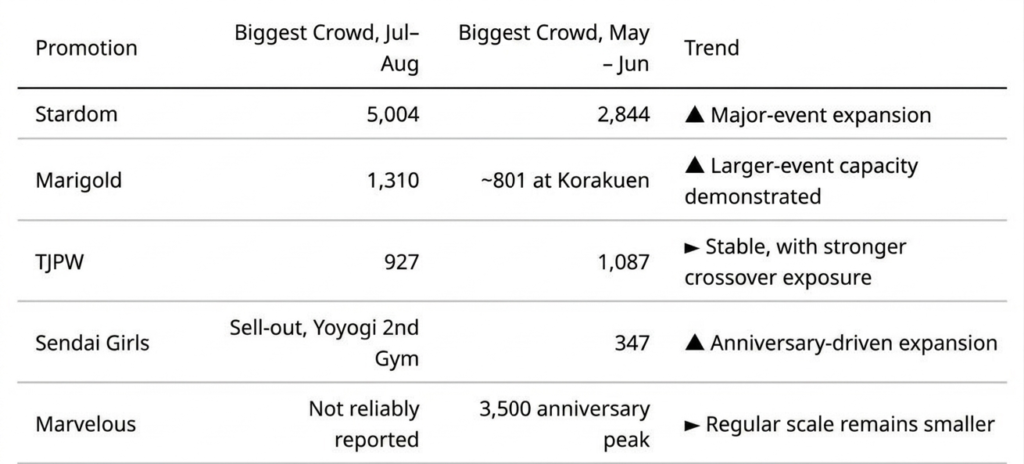
The stark reality here is fragmentation. The top of the card is thriving, but smaller promotions without a digital footprint or a distinct event proposition are going to get left behind. We can track attendance all day, but until we get more transparency on operating margins, sponsorship income, and merchandise, ticket sales remain our best barometer for actual momentum..
The Index Ratings
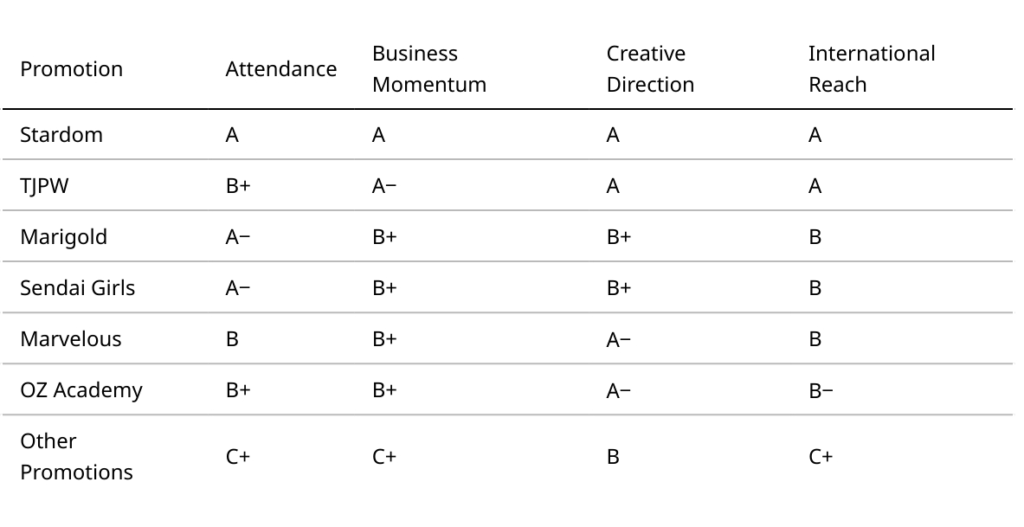
Heading into autumn, the ultimate test for this industry isn’t who drew the biggest crowd in August. It’s who can take that summer peak and convert it into repeatable, sustainable demand when the tournament trophies are packed away.