Translated from Japanese for Archival & Critical Preservation
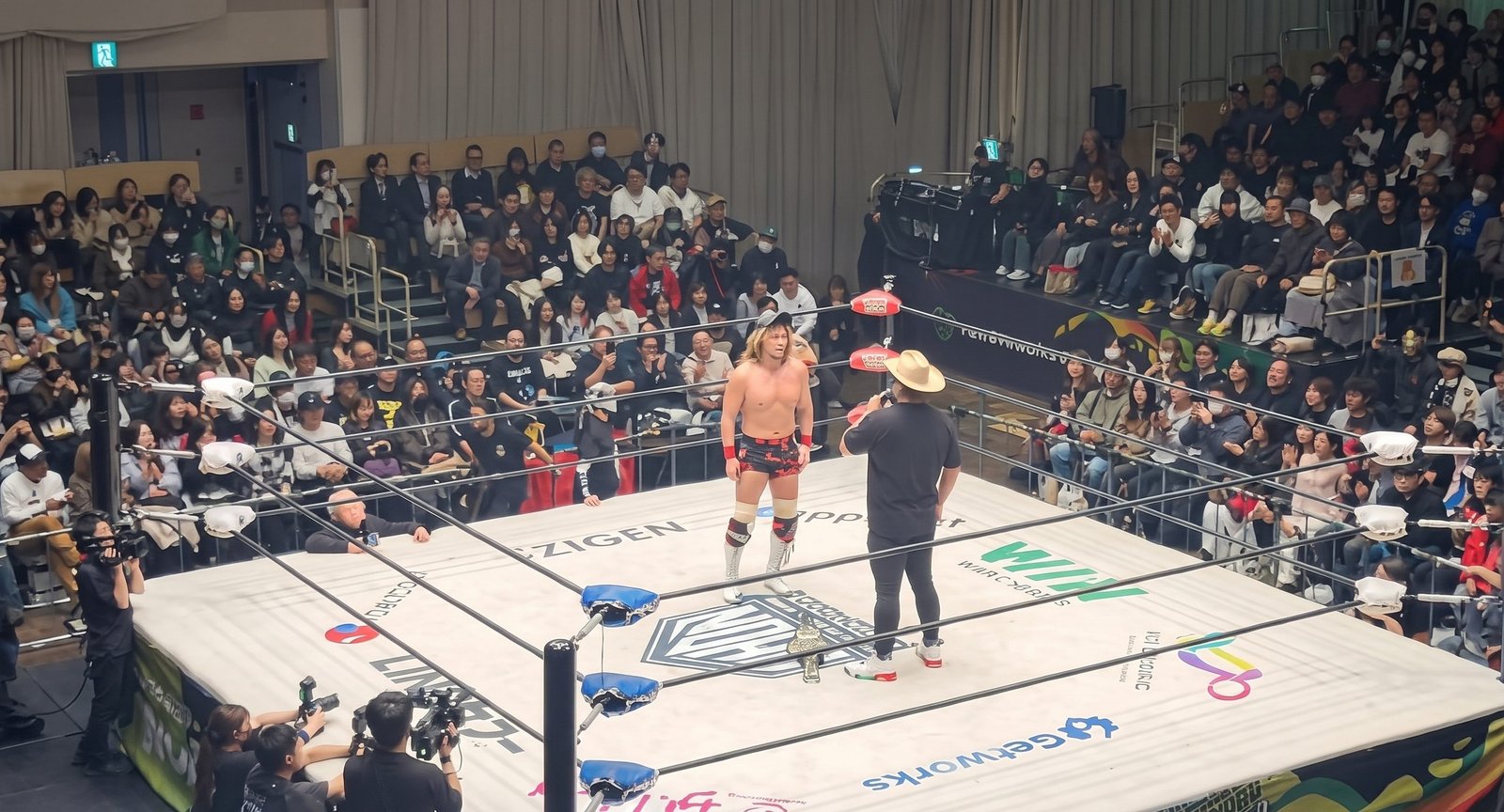
As previewed in the previous column, Giulia attended Pro Wrestling NOAH’s November 9 Korakuen Hall event and says she could not help but shed tears while watching the GHC Heavyweight Championship match between Tetsuya Naito and Kenoh. What was the reason behind it…?
Archival Dossier
- Column: Giulia’s Troublemaker Syndrome (Giulia no Osawagase Shoukougun / Sindrome), Vol. 192
- Source: Weekly Pro-Wrestling, Page 93
- Event Covered: Pro Wrestling NOAH, November 9, Korakuen Hall (Tokyo)
- Featured Bout: GHC Heavyweight Championship, Tetsuya Naito vs. Kenoh
- Other Performers Noted: Yoshiki Inamura (six-man tag match) and NOAH rookie Namiki-kun
- Vantage Point: Korakuen Hall second-floor balcony, attended during Giulia’s WWE tenure
Interviewer: Did you go see NOAH’s November 9 Korakuen Hall show that you talked about last time?
Giulia: I went! I was cheering and shouting things like “Come on, Naito!” and “Inamuraaa!” and I also thought that NOAH rookie, Namiki-kun, looked really good. The little mannerism right before he turned around, that split-second movement, had a real presence to it, and it made me think, “This guy’s going to become really cool.” The six-man tag match Inamura-kun was in was good, too. From the first match all the way to the main event, the whole show was fun.
Interviewer: What about the much-anticipated Naito vs. Kenoh match?
Giulia: The cheers from the NOAH fans when Kenoh-san made his entrance were great, and the moment Naito-san’s theme music hit, the way the crowd erupted gave me goosebumps.
Interviewer: How was the match?
Giulia: I surprised even myself, but I ended up crying. Lately on social media and places like that, people have been writing things like “[Naito has] declined” and “He can’t move anymore,” and honestly, I thought that was true. Kenoh-san was also wonderful for making a bout with Naito-san in that state work and getting the crowd fired up. Still, what hit me in the heart was Naito-san laying everything bare, showing his uncool side, his battered body, and even the pathetic parts, fighting desperately anyway. It brought me to tears, seeing him shave away his own life to fight.
Inochi wo kezuru (命を削る, shaving away one’s life): Harsher and more physical than the interviewer’s follow-up phrase about putting one’s life on the line. Literally meaning to whittle or shave down one’s lifespan, the idiom emphasizes the visible physical toll Naito was absorbing in the ring.
“Watching Naito-san lay bare all of his uncool and pathetic sides as he fought brought me to tears…”
– Giulia
Interviewer: Putting his life on the line.
Giulia: Of course, every pro wrestler puts their life on the line when they fight. It’s just that a few years ago, nobody could have imagined seeing Naito-san like this, right? Back when I was a fan, I cheered for Naito-san while he was tearing it up with Los Ingo, and I loved that version of Naito-san too, but I love the current Naito-san even more.
Los Ingo (ロス・インゴ): Common Japanese shorthand for Los Ingobernables de Japon, the faction Tetsuya Naito led during his peak years in New Japan Pro-Wrestling.
Interviewer: Why is that?
Giulia: The way my perspective on pro wrestling changed after becoming a wrestler myself probably has a lot to do with it. I went through a period where I thought about “taking moves” too, and every time I watched Naito-san’s matches, I used to wonder how this guy could put his body on the line to this extent.
Uke (受け, taking moves): In Japanese pro wrestling, uke describes the craft of absorbing an opponent’s offense, taking bumps cleanly, and selling attacks so the bout feels real. Giulia puts the word in quotation marks to frame it as a specific technical philosophy she studied after turning pro.
Interviewer: During his New Japan days?
Giulia: Yeah. There are some wrestlers out there who are like “athletic freaks,” and compared to them, Naito-san was never someone with extraordinary physical ability, so he seriously put his body on the line and took moves with total abandon. That felt so real to me, and I’ve always respected him for it. Paying the price for putting his body on the line for pro wrestling left him completely torn to shreds. Even so, Naito-san still staggered back up to his feet, sometimes even losing his balance while he was the one on offense. Or he’d get beaten down so badly he’d lie there motionless like he was dead. Watching him even made me worried, and precisely because of that, “Come on, Naito-san!” came out from the bottom of my heart, and before I knew it, tears were falling.
Shintai Nouryoku Obake (身体能力おばけ, athletic freaks) and Sutemi (捨て身, total abandon): Literally “physical ability monsters,” the first term is colloquial Japanese praise for naturally explosive athletes. Sutemi literally means discarding one’s own body to take heavy impact without self-protection, leaving a wrestler zutaboro (ズタボロ, torn to shreds). Note also how Giulia shifts from shouting “Naito!” like a fan in the opening answer to “Naito-san!” here, reflecting peer-level respect.
Interviewer: That’s not a feeling you can get from short clip videos.
Giulia: Well, I understand how the people complaining feel. Still, that’s exactly why I want to say it: the Tetsuya Naito of today is a wrestler who stirs up fans’ emotions this intensely. Even complaining takes energy, after all. And I might get yelled at for saying something like this, but from Naito-san, I even felt a kind of fragility, like a candle straining to give off its last remaining light.
Kirinuki Douga (切り抜き動画, short clip videos) and Hakanasa (儚さ, fleeting fragility): Kirinuki douga refers to short highlight or botch clips circulated on social media platforms, contrasted here with the emotional weight of watching a full bout live. Giulia pairs hakanasa (poignant fragility) with furishiboru (振り絞る, squeezing out every last drop of strength) for her closing candle image.
Interviewer: Will the candle’s flame go out, or will it…?
Giulia: Something might spark it from here and make it blaze brightly again, you never know. Going to see NOAH this time reminded me all over again how interesting Japanese pro wrestling is, and I got to see a lot of people, too. It made me feel like everyone is living with all their might in their own place. I’m going to put in every bit of effort I can right now and work hard to survive right where I am, in WWE. Until next time, arrivederci, see you!
Ikinobiru (生き延びる, to survive) and Arrivederci, see you! (アリベデルチ・シーユー!): Rather than using a generic phrase for doing her best, Giulia chooses ikinobiru (to survive or outlast), reflecting the competitive reality of holding a spot on the WWE roster before closing with her longtime bilingual sign-off.