Labor, Lineage, and Unbound Co.’s Debut PPV



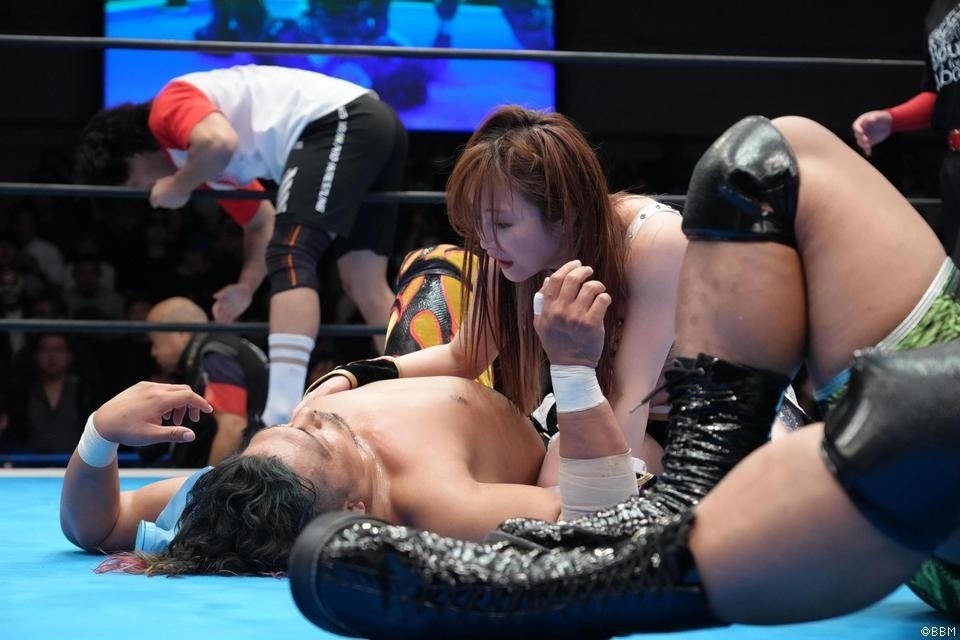
When people talk about special mixed tag team matches, they usually file them away as novelty entertainment, a lighthearted detour before the serious business of tournaments and title chases resumes. Look a little closer at what happened on the very first pro-wrestling show produced by Unbound Co., “Bound for Unbound,” and you start to see something much more revealing. On the surface, Shingo Takagi and Natsupoi defeating Jeff Cobb and Chihiro Hashimoto in 22 minutes and 10 seconds was a warm, celebratory sendoff for a real-life married couple before Natsupoi retires on January 3. Underneath that celebration, though, sits a candid snapshot of how modern Japanese pro wrestling actually operates, from corporate boundaries between promotions to the unspoken social pressures placed on wrestlers when their personal lives intersect with the business.
Archival Dossier
- Event: Bound for Unbound (Unbound Co.’s maiden pro-wrestling show, broadcast on PPV).
- Result: Shingo Takagi and Natsupoi def. Jeff Cobb and Chihiro Hashimoto (Team 250kg) via Pumping Bomber Hold (22:10).
- Marital Tag Record: 2-for-2 (100% win rate in their final scheduled outing together).
- Veteran Workload: 18 matches in 24 days for Takagi (turning 44 the next day, in his 23rd career year), entering Tag League alongside Moloney as WAR DRAGONS.
- January 3 to 5 Ledger: Natsupoi’s retirement match at Yokohama Budokan (January 3); Takagi’s Special Unbound Deathmatch against Jon Moxley at the Tokyo Dome (January 4); targeted tag title match (January 5).
Now, look at the structural reality framing this match before the opening bell even rang. Pro wrestling has always asked performers to blur the line between their real lives and their public personas, yet the institutions themselves rarely make that easy. As Takagi noted backstage afterward, simply announcing his marriage to Natsupoi back in January felt “kind of miraculous” once you factored in the corporate relationship between Stardom and New Japan. Getting the space to train together at the New Japan Dojo and then share a ring as husband and wife on a PPV broadcast does not happen by accident in an industry built on rigid promotional walls. Even the format of the evening carried weight. This was Unbound’s maiden voyage as a show-producing unit, airing on PPV and testing what a faction-branded card can pull off when it steps slightly outside traditional booking lanes.
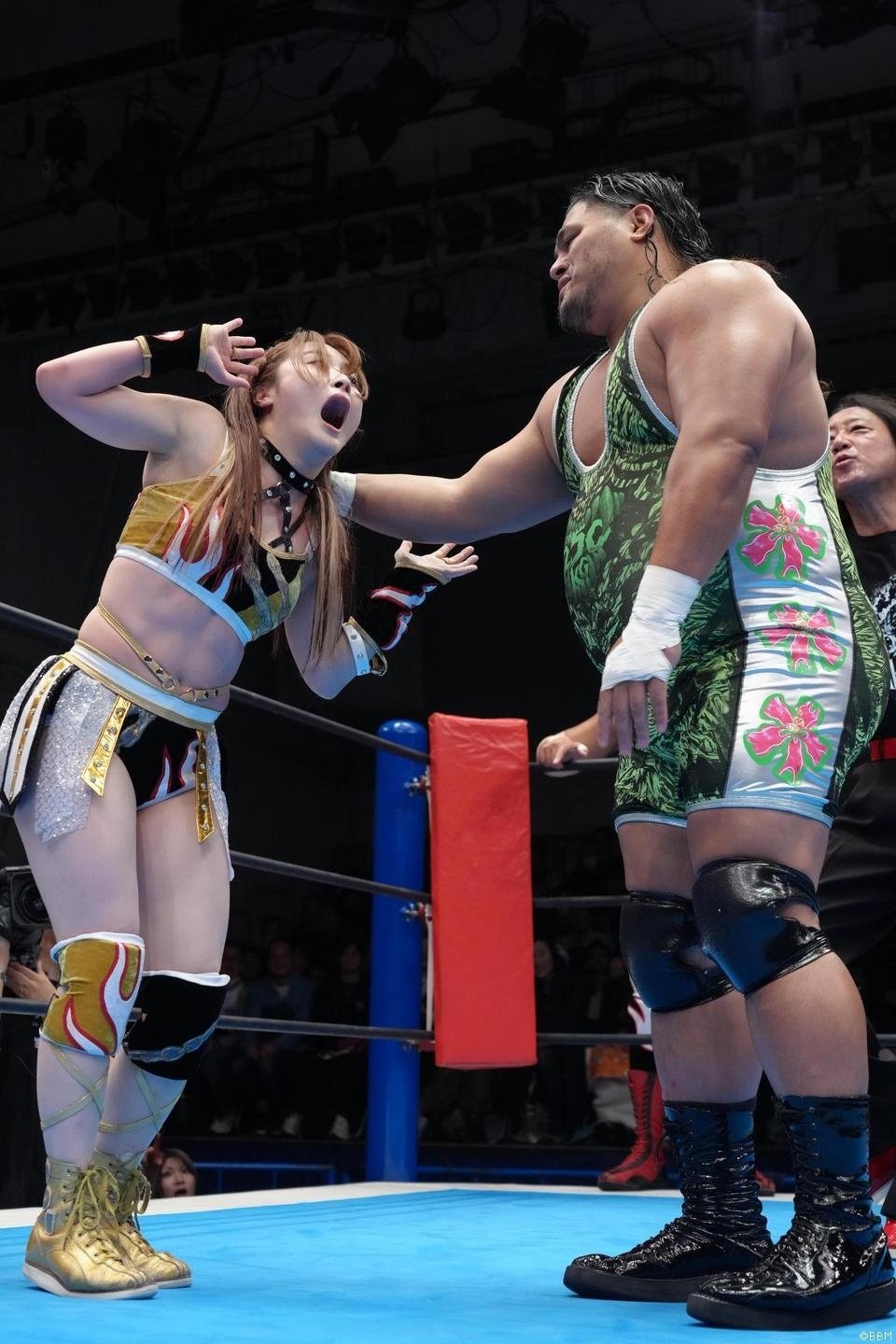
And to be fair, the four people in the ring understood the assignment right from the entrances. Cobb and Hashimoto leaned straight into their physical identity, teaming up as “Team 250kg,” with Cobb even slipping into his own take on Hashimoto’s trademark gear. From the south side, Takagi and Natsupoi countered with their own visual statement, Natsupoi walking out in a robe tailored to match her husband’s. Even before anyone locked up, the contrast was clear: raw, combined mass and mat pedigree on one side against a unified marital partnership on the other.
What unfolded over the next 22 minutes exposed one of the most interesting cultural fault lines in intergender wrestling, namely how an audience decides which matchups feel fair and which ones trigger discomfort. Hashimoto actually held Cobb back to start the match herself, stepping directly across from Takagi. Rather than playing for comedy, she went straight to work and drew a genuine reaction from the crowd with her ground game. Takagi had to wrench her leg just to create space before tagging in Natsupoi. After a brisk exchange, Natsupoi landed a low dropkick, and Takagi bodyslammed Natsupoi onto Hashimoto. Cobb and Hashimoto quickly reminded everyone of their weight advantage by sandwiching both opponents between them. Back inside the ring, Hashimoto launched Natsupoi with a Tawara-nage, the traditional overhead rice-bale throw.
Tawara-nage (俵投げ, rice-bale throw): A high-angle overhead throw rooted in Japanese grappling traditions, lifting an opponent from the waist and launching them backward over the shoulder.
Here is where the room shifted. When Hashimoto tagged in Cobb to face Natsupoi, a visible stir rippled through the arena, and boos rang out the moment Cobb lined up to stomp on her. It is a telling bit of crowd psychology. Fans had no trouble cheering Hashimoto grappling shoulder to shoulder with Takagi, because Hashimoto carries the aura and physical credibility of an elite powerhouse. Put a heavyweight man over a smaller female wrestler, however, and the audience’s protective instincts kick in immediately.
Fans had no trouble cheering Hashimoto grappling shoulder to shoulder with Takagi, because Hashimoto carries the aura and physical credibility of an elite powerhouse. Put a heavyweight man over a smaller female wrestler, however, and the audience’s protective instincts kick in immediately.
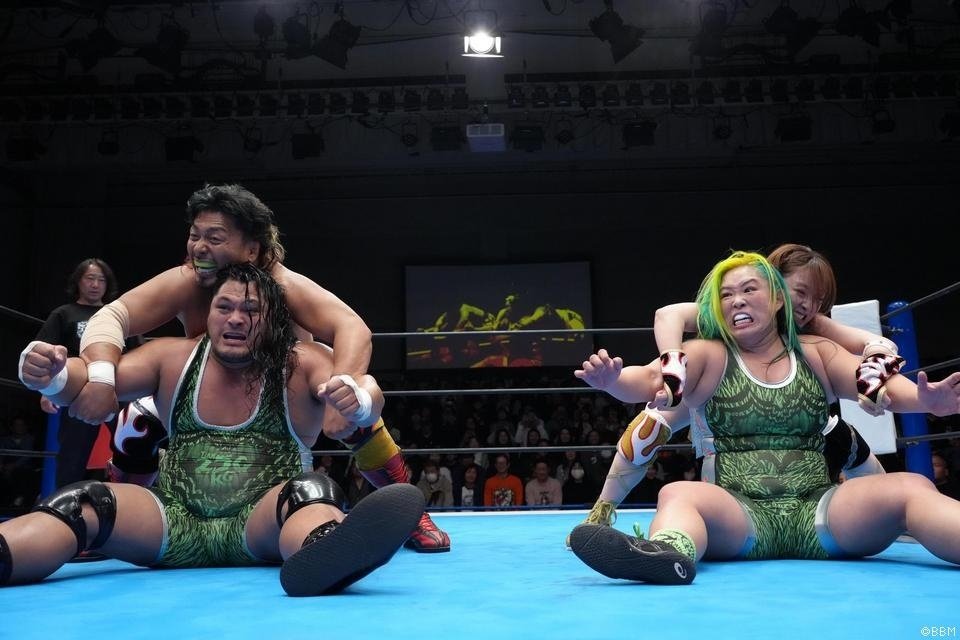
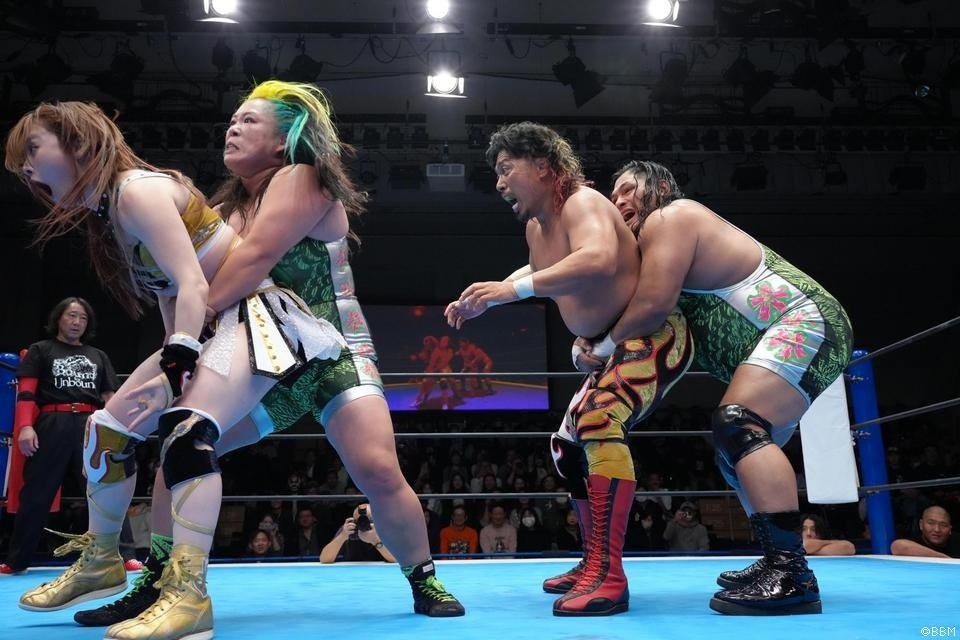
At the five-minute mark, Cobb leaned right into that tension and went through with the stomp, forcing Takagi to rush in for the break. Cobb did not back down, catching Takagi with a dropkick and a body press, with Hashimoto flying in right behind him to add a body press of her own. Cobb then scooped Natsupoi up and handed her off to a newly tagged-in Hashimoto for a brainbuster, swinging control firmly toward Team 250kg. Hashimoto dropped Natsupoi with a heavy hammer blow to the chest, and though Natsupoi fired back with a facecrusher, tagging Cobb back in brought the size discrepancy back into sharp focus. Natsupoi’s desperate hammer blows failed to faze him, and her crossbody bounced right off his frame. Still, she kept her composure, evaded his standing moonsault, and tagged out to Takagi. Takagi charged in with a corner attack, unloaded strikes, hit an arm whip, and won a brainbuster exchange for a two-count. Hashimoto broke up his signature “Kita, Kita, Kita!” sequence, yet Takagi and Natsupoi showed their timing by avoiding a collision with each other, sending Cobb and Hashimoto crashing together instead before locking in stereo WAR Specials.
By the 10-minute mark, the match settled into the kind of heavy-handed physicality that makes fans forget about novelty stipulations altogether. Takagi and Cobb locked up in a knuckle-lock test of strength. Takagi transitioned into a double-wrist armsault, and Cobb answered with an Exploder. After colliding on simultaneous lariats, Takagi finally knocked Cobb down with a Ryukon Lariat. When Hashimoto and Natsupoi re-entered, the pace stayed relentless. Hashimoto hoisted Natsupoi into an Argentine backbreaker, spinning and slamming her down, only for Natsupoi to trap her in a triangle choke. Hashimoto answered with sheer power, lifting Natsupoi straight up and slamming her to the mat before catching her and spiking her with a German suplex. Natsupoi refused to fold, answering with a palm strike and a thrust kick. Takagi stepped in looking for a Bizan, the multi-person German suplex spot, and when it fell short, he adjusted on the fly by lifting Natsupoi and dropping her onto Hashimoto. After a double “Kita, Kita, Kita!”, Takagi bodyslammed Hashimoto and Natsupoi connected with a Fairy Press for a two-count. They followed with another tandem attack on Hashimoto, forcing Cobb to jump in and make the save at two.
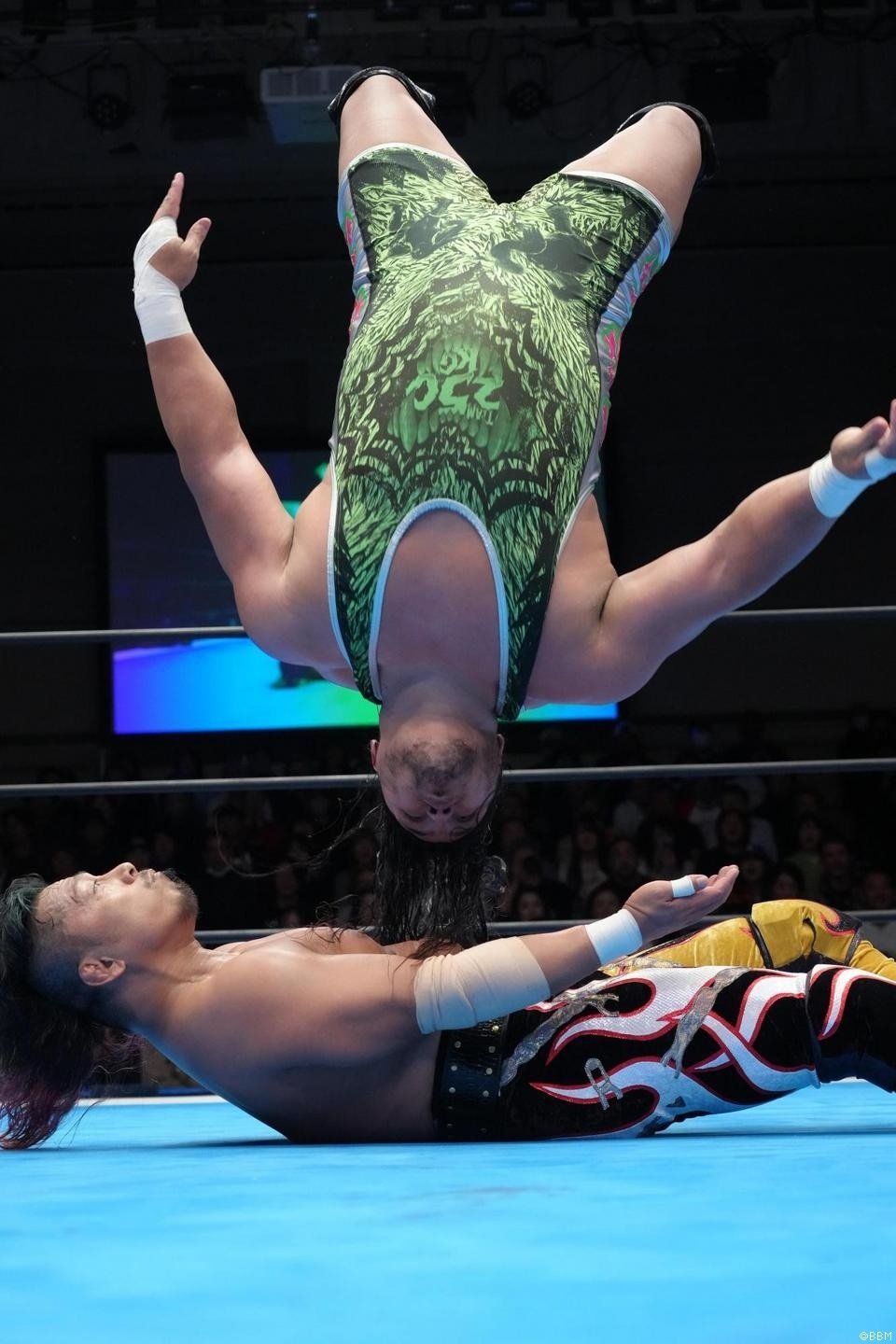
Past the 15-minute mark, the scale of the match tipped into pure spectacle. A double Made in Japan attempt got cut off, and Cobb answered with a devastating modified Bizan, launching all three other competitors at once with a single German suplex. Hashimoto then blocked a German suplex of her own and flattened Natsupoi with a lariat. Takagi had to pull Natsupoi across to make the tag, catching Hashimoto with a knee, yet Hashimoto took it and came right back with a brainbuster. She followed with a lariat, ducked a Ryukon Lariat, and rattled off a release German suplex and another lariat in a stretch that left no doubt about her standing in that ring. Tagging back in, Cobb rammed Takagi into the corner, planted him with an Athletic Plex, and landed a standing moonsault for a two-count. Natsupoi rushed in to break up the momentum, only for Cobb to brush her aside. Even so, she stayed alert, cutting off Cobb and Hashimoto just as they set up for a double body press from the corner.
Crossing the 20-minute mark, Takagi emptied the tank. He hit Cobb with an avalanche brainbuster from the top rope, followed by a corner lariat, a Pumping Bomber, and a Takagi Shingo Death Rider, a pointed nod to Jon Moxley’s finisher ahead of his upcoming January 4 assignment. The save came just in time at two. To clear the board, Natsupoi launched herself at Hashimoto with a body attack to the outside. Back in the ring, Takagi hammered Cobb with left and right elbows. Cobb dug deep, hit a German suplex, and hoisted Takagi up for another, but Takagi countered out and secured the three-count with a Pumping Bomber Hold at 22:10.


Once the bell rang, the microphone work turned into a study in how veterans hold a crowd, honor wrestling history, and hint at future business all in one breath. Takagi opened by addressing Cobb directly: “Jeff Cobb! You’re as strong as ever! Thank you for coming back to Japan. Let’s tear it up again in this New Japan ring as Unbound.” Then he turned to Hashimoto, playfully borrowing Riki Choshu’s famous tirade aimed at Shinya Hashimoto as a nod to her surname: “And Hashimoto! Hey Hashimoto, what the hell, you punk, hey! Hashimoto, you really are a monster. I figured an opportunity like this would never come around again and that today would be the first and last time, but Hashimoto vs. Shingo Takagi, wouldn’t it be alright to do that again? Right? Whether we fight again or team up, either works for me. Thank you for today.” They shook hands, a simple gesture that underscored how seriously Takagi treated her as an equal across the ring.
Riki Choshu’s Hashimoto Tirade (コラ橋本、コラ!): Takagi’s post-match rib borrows the cadence of Riki Choshu’s widely quoted verbal outburst directed at New Japan icon Shinya Hashimoto, repurposing a familiar piece of NJPW locker-room lore to salute Chihiro Hashimoto’s power.
Then came the heart of the night, directed straight to his wife. “And then, Poi-san! Thank you for today,” Takagi said. “Looking back, we announced our marriage this January, and I kept wishing that someday we could train together at the New Japan Dojo and team up in a match. Today, that wish came true. All I’ve really got going for me is my energy, so once again, thank you for marrying me. Poi-san is retiring on January 3. Just a little over a month left. Right up until the very end, please keep pushing down your own path in your own way. Today is Unbound’s very first pro-wrestling show. Hey, Unbound members! Come on out, come on out!”

As the rest of Unbound filed into the ring, Takagi shifted into promoter and provocateur mode. Look closely at what he did next, because it shows how sharply tuned he is to both the current business and the weight of New Japan history. “Today was the very first Unbound-produced show, and it wouldn’t be any fun if it ended as a one-off, right? Let’s do it one more time, no, let’s do it as many times as we want!” he told the crowd. “Today’s show was on PPV too. Hey, hey, hey, I heard BUSHI showed up as Marlowe Mask’s opponent. Hey, if BUSHI can show up, wouldn’t it be fine for Tranquilo to show up too?! Putting aside whether that’ll happen or not, let’s keep it together.” Throwing that line out on a PPV broadcast is classic wrestling instinct, reminding fans that faction-run shows thrive on unpredictability and open doors.
Tranquilo (Spanish, stay calm or relax): The signature catchphrase long associated with Tetsuya Naito and the Los Ingobernables de Japón circle. Invoking it right after mentioning BUSHI’s appearance on the undercard operates as a calculated tease on an open PPV stage.
From there, he navigated a wonderfully awkward piece of institutional lineage. “Shall we close things out? To explain it simply, just like Antonio Inoki-san, with the utmost respect for Inoki-san, we’ll do ‘1, 2, 3, Kitaaa!’ Wishing for happiness to come to everyone, with ‘Kitaaa!’ I didn’t know this, but apparently Inoki-san’s grandson joined this week. Even though Inoki-san’s grandson just joined as a trainee, here’s Shingo Takagi doing ‘1, 2, 3, Kitaaa!’ I thought that might be a little awkward, but ‘Forcing My Way’ is my motto. I’m going all the way with it! Bound for Unbound, did you enjoy yourselves all the way to the end?! Here we go! 1, 2, 3, Kitaaa!” Even in a playful sign-off, you hear the delicate balancing act every veteran faces in New Japan, respecting the sacred ghosts of the company’s founder while stubbornly carving out their own identity. Afterward, Cobb played matchmaker for the crowd, calling out, “Takagi-san, Natsupoi, please kiss.” A “Kiss!” chant swept through the arena, and Natsupoi kissed Takagi on the cheek to send everyone home smiling.
“1, 2, 3, Kitaaa!” (1、2、3、キター!) and Inoki’s “Daaa!”: Takagi’s closing call adapts New Japan founder Antonio Inoki’s signature “1, 2, 3, Daaa!” sign-off into his own “Kita!” catchphrase, turning an awkward generational overlap with Inoki’s newly enrolled grandson into a stubborn personal trademark.
Still, if you want to understand the real human cost and career anxiety sitting behind that happy ending, you have to listen to the backstage comments. That is where the glossy highlight reel gives way to the actual working conditions of pro wrestling.
“Man, that was brutal,” Takagi admitted as they walked back. “Both Jeff and Hashimoto really got to me. Wasn’t I the only one taking a beating out there? No?”
Natsupoi was not letting him rewrite history. “No, that’s not true at all!”
“I was getting beat up the whole first half and beat up the whole second half,” Takagi laughed. “Still, somehow, as the Takagi husband-and-wife team, we’re 2-for-2. That winning percentage is unreal, isn’t it?”
“Yeah, it really is,” Natsupoi agreed.
Then the reality of the calendar set in. “We might have a 100% winning record, but unless some really sudden offer comes in, today is the last time,” Takagi said. “Poi-san is retiring on January 3, after all. Most of it I already said in the ring, but even announcing our marriage was kind of miraculous. There’s the relationship between Stardom and New Japan to consider, too. Making the announcement was a miracle, and well, me getting married in the first place is a miracle itself, so in the middle of all that, being able to train together at the New Japan Dojo and team up in a match like this is the best memory of all.”
Natsupoi echoed that gratitude quietly: “Really, yeah. Training together at the dojo and teaming up as husband and wife had been my dream for so long, so thank you for making that dream come true.”
Let’s be real for a second about what Takagi said next, because it lays bare two massive truths about wrestling labor that rarely get spoken aloud this plainly. First, there is the sheer absurdity of the holiday schedule. “Well, there’s still more ahead,” Takagi said. “She has her retirement match at Yokohama Budokan on January 3, and on January 4, right next door at the Tokyo Dome, I have a Special Unbound Deathmatch. Man, that’s crazy. Right after her retirement match, mine might end up becoming a retirement match too.”
“Stop saying that!” Natsupoi shot back.
Second, and perhaps more telling, is the gendered scrutiny that follows a married couple in this business when one partner steps away. Takagi is in his 23rd year as a pro wrestler, and he knows exactly how the rumor mill and fan commentary work when a wife retires while her husband is in a slump. “Well, I’m in my 23rd year as a pro wrestler, so I’ve just got to go out there and do it,” he said. “I’ll step onto Moxley’s turf, right in the heart of greater Tokyo, at the Tokyo Dome, and light the signal fire. We went out of our way to announce our marriage this year, and going back to last year as well, results haven’t gone my way. I think people are thinking and saying, ‘What did [Natsupoi] retire for? Didn’t she retire to support Takagi?’ So next year, I’m going to make sure I deliver results.”
I think people are thinking and saying, ‘What did [Natsupoi] retire for? Didn’t she retire to support Takagi?’ So next year, I’m going to make sure I deliver results.
– Shingo Takagi, backstage after Bound for Unbound
Pause on that quote for a moment. Whether or not fans mean it maliciously, there is a deep cultural habit in both sports and everyday life of viewing a woman’s retirement as a sacrifice made strictly for her husband’s career, and then measuring his win-loss record as proof of whether that sacrifice was worth it. Takagi is feeling that pressure directly, and his answer is to double down on an almost punishing workload. “First, before that, there’s the Tag League starting next week!” he continued. “With Moloney as WAR DRAGONS, the Kita-Kita Brothers, we’re going to deliver results there, and whether our opponents are KOB or anyone else, I’m going in intending to have another tag title match on January 5. Starting next week, no, starting today, it’s 18 matches in 24 days. Pro wrestling is wild. Pro wrestlers are something else. Poi-san, keep charging full speed ahead right to the end too. Thank you.”
Eighteen matches in 24 days, leading straight from a wife’s retirement at Yokohama Budokan on January 3 to a Tokyo Dome deathmatch on January 4 to a hopeful tag title shot on January 5. Right in the middle of that whirlwind, Natsupoi grounded the moment with a simple reminder of the human clock ticking underneath the tour schedule: “Takagi-san, it’s tomorrow, but happy birthday!”
“Oh, that’s right,” Takagi replied. “Thank you. Forty-four caliber.”
Even the final beat backstage carried a quiet contrast, as Hashimoto listened to Cobb’s comments, offered a crisp “Thank you very much!” and walked out, already moving on to whatever awaits her next.
That is really what makes this night linger after the cheek kiss and the celebratory chants fade. Pro wrestling does not slow down for birthdays, anniversaries, or farewells. It asks a 44-year-old veteran in his 23rd year to wrestle 18 times in 24 days just to prove he can still carry the weight of expectations, while his partner counts down her final weeks in the business she built her life around. Getting one night where the promotions align, the crowd lets its guard down, and two workers actually get to claim a memory for themselves before stepping back into the meat grinder is no small thing. The schedule will still be waiting tomorrow morning, unforgiving as ever, but at least they walked out 2-for-2 on their own terms.
Originally published in Japanese on Weekly Pro-Wrestling’s (週刊プロレス / Shukan Puroresu) website. Published by Baseball Magazine Sha Co., Ltd. (ベースボール・マガジン社). All original Japanese text and photography copyrights belong to Baseball Magazine Sha Co., Ltd. and their respective creators. This English translation and archival localization is produced for historical documentation, critical commentary, and international journalistic accessibility. Readers are strongly encouraged to support the original Japanese creators by purchasing print or digital editions of Weekly Pro-Wrestling and subscribing to Weekly Pro-Wrestling Mobile Premium (週プロモバイルプレミアム).