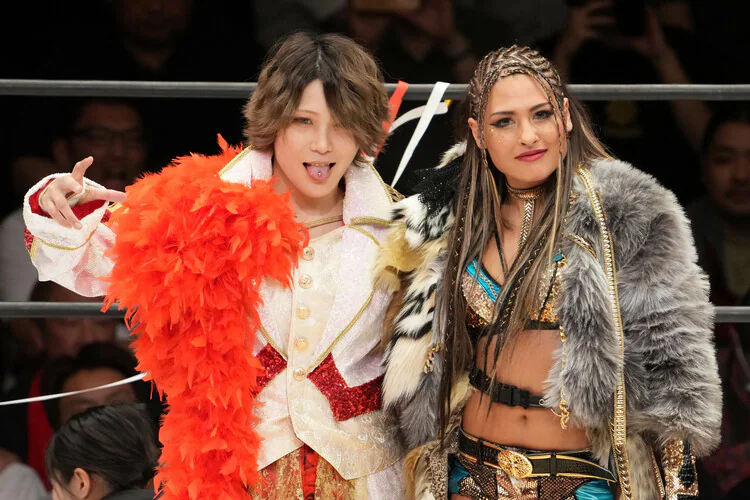
In the 190th installment of her Giulia’s Troublemaker Syndrome column, WWE’s Giulia reflected on the current trajectory of her former Stardom and Dream Star Fighting Marigold colleague, Utami Hayashishita. Looking at Hayashishita’s run since returning to Stardom in May, Giulia examined why her former tag partner has come across as unusually reserved and what it will take for her to break out of that shell against Saya Kamitani, while also offering her assessment of Marigold’s recent big event at Ryogoku.
Interviewer: Do you watch Japanese pro wrestling lately?
Giulia: I do watch it. I buy PPVs, or when everyone gets together, we watch on streaming services. Recently, things like Stardom’s 5★STAR. We’ll all be making a fuss together saying things like, “Iida’s popularity is crazy!” (laughs).
Interviewer: Did the matches of Utami Hayashishita, who is from the same debut class as Saya Iida and returned to Stardom in May, catch your eye?
Giulia: Utami, huh. Right now in Stardom, new power is sprouting up, isn’t it? You can really feel how hard the three sisters—including the 19-year-old Rina, who won the 5★STAR—are working. Her direction is different, but I can also feel how desperate Maki Itoh is to grab attention. And Kamitani is on a total roll, right? With Utami, now that the commotion around her transfer has settled down, I honestly couldn’t tell what she wants to do right now.
Interviewer: Stardom has a deep roster, and Utami doesn’t have the image of being the type to aggressively push her way to the front.
Giulia: With Utami, I think she’s someone who has an especially strong desire not to get bashed. For Utami to leave Marigold and return to Stardom, I think that was a huge decision that took a lot of courage. Utami is strong and has a proven track record, so from the perspective of the newer girls, she’s like an obstacle standing right in their way. When that happens, no matter what, fans who bash her are bound to come out. So my impression is that she’s keeping quiet so she stands out as little as possible.
Interviewer: People say that for a pro wrestler, standing out is the whole point, though?
Giulia: Well, that’s true, but in today’s social media society, fans say whatever they please. There are people who don’t let that bother them, and there are people who get hurt by it. And then there are even people who snap right back at every little thing (laughs).
Interviewer: Even so, we’d like to see a massive explosion from Utami strong enough to outshine her target, Kamitani.
“I’m looking forward to seeing how Kamitani cooks up the somewhat reserved ‘current Utami.'”
Giulia: Me too. What I thought watching the exchanges between the two of them is that what Kamitani is saying leaves very little room to counter. When it’s like that, it’s a little hard to build heat (laughs). Right now, Kamitani is at the top of Stardom and Japanese pro wrestling, right? Depending on how she phrases things, she can make her opponent look bad, or she can do the opposite. There’s no need to flatter them at all, but if you simply say things your opponent hates, it can sometimes look like bullying. Especially when the opponent has few allies or friends on their side. If the person standing on top says all sorts of things while leaving a few holes that are easy to poke at, Utami can fire back with everything she’s got, and it makes it easy to create a “Go get her, Utami!” atmosphere. That’s something I kept lightly in the back of my mind when I was in Japan. If you just completely shut the other person down, the conversation has nowhere to go—it’s the exact same as a marital spat (laughs). I’m looking forward to seeing how Kamitani cooks this up from here. Well, from the perspective of Kamitani’s fans, it’s probably, “Who are you to talk when you’ve never even won MVP!” (laughs).
Interviewer: Finally, your former home promotion Marigold held its Ryogoku event.
Giulia: Now that they have a producer and have reached the point where they can put on proper matches, what comes next depends on how they roll out the storylines leading into big matches, right? What do you roll out, and how do you build it toward a big match that is already booked half a year or a year in advance? Looking at it from the outside, the relationships between the wrestlers feel a bit thin. There are times when those dynamics form on their own, but when that’s difficult, that’s where Ogawa-san gets to show what he can do. Rather than just lining up one-off match cards, I want them to build rich, compelling rivalries that get everyone invested. Creating something that makes people think, “I want to see this,” is probably the theme for their third year, isn’t it? I’m looking forward to Marigold’s new chapter. Until next time, arrivederci, see you!
Translation Notes:
- Speaker Labels (
ジュリア番/G番andジュリア/G): In the print layout, the interviewer is labeledジュリア番(以下G番)(literally “Giulia beat reporter, hereafter G-ban”) and Giulia is abbreviated asG. These have been standardized to Interviewer: and Giulia: for clean digital reading. - “Returning to one’s old home” (
出戻った– demodotta): In the second question, the interviewer describes Utami Hayashishita’s May return to Stardom using the verb demodoru (出戻る), a colloquial term originally used for a divorced person returning to their parents’ home, and commonly used in Japanese sports/wrestling journalism for a talent returning to their original promotion after leaving for another company. - Editorial Parentheticals: In Column 1, the magazine editor inserted
(5★STARを制した19歳の)(“who won the 5★STAR at 19 years old”) before吏南(Rina), and in Column 3 inserted(それが)(“those dynamics”) to clarify the omitted subject. Both have been smoothly integrated into the English prose. “The three sisters” (三姉妹) refers to Stardom’s real-life sisters Hanan, Hina, and Rina. - “An obstacle standing right in their way” (
目の上のタンコブ– me no ue no tankobu): Literally “a lump/bump above the eye.” This classic Japanese idiom refers to someone of higher status, seniority, or ability who acts as an intimidating obstacle or nuisance to those trying to rise up from below. - “Standing out is the whole point” (
目立ってナンボ– medatte nanbo): A colloquial Kansai-originated phrasing (〜てナンボ) meaning that a person’s or profession’s worth is defined entirely by doing that action—in this case, a pro wrestler’s value is measured by how much attention they draw. - “Leaving very little room to counter” (
突っ込み所少ない– tsukkomidokoro sukunai): Drawn from manzai comedy terminology (boke and tsukkomi), tsukkomidokoro refers to openings, flaws, or contradictions in someone’s argument where the other person can jump in and retort. Giulia is pointing out that when a top champion’s promo is too airtight and ruthless without leaving deliberate vulnerabilities (“holes” /穴), the challenger has no rhetorical opening to rally the crowd behind them. - “How Kamitani cooks this up” (
どう料理するのか– dou ryouri suru no ka): Figuratively “how she handles/deals with her,” using the culinary metaphor of “cooking” or preparing an opponent in a feud to bring out their flavor. - The MVP Self-Deprecation Joke: When Giulia jokes, “From the perspective of Kamitani’s fans, it’s probably, ‘Who are you to talk when you’ve never even won MVP!'”, she is referencing Saya Kamitani winning the overall MVP in the Tokyo Sports Pro-Wrestling Awards (alongside the Women’s Wrestling Grand Prize), whereas Giulia won the Women’s Wrestling Grand Prize during her time in Japan but never captured the overall MVP award.
- Marigold’s “Producer” and
小川さん(Ogawa-san): In her final answer regarding Marigold’s Ryogoku Kokugikan event, Giulia mentions小川さん(retained as “Ogawa-san”), referring to Marigold founder and executive producer Rossy Ogawa, and evaluates the promotion’s transition as it enters its third year.